
Crystallization: yield from solubility and the MSMPR size distribution#
difflow.units.crystallizer has the solubility / yield library (cooling, evaporative, hydrates), the MSMPR
population balance with power-law kinetics, and the Crystallizer palette unit.
Every curve and kinetic constant below is SYNTHETIC (illustrative). The sucrose, Na\(_2\)SO\(_4\) and Na\(_2\)CO\(_3\) solubility data and the published worked examples (Geankoplis Sec. 12.11, McCabe Ch. 27, Wankat Ch. 17) are not reproduced: their numbers could not be recalled with confidence, so the notebook checks the closed forms against independent numerical oracles instead.
import math
import jax, jax.numpy as jnp, numpy as np
import matplotlib.pyplot as plt
from scipy import integrate
jax.config.update("jax_enable_x64", True)
from difflow import (Solubility, crystal_balance, crystal_yield, supersaturation, Crystallizer, CrystallizerParams,
                     make_stream, msmpr_distribution, msmpr_moments, msmpr_dominant_size, msmpr_mass_median_size,
                     fit_msmpr, msmpr_steady_state)
K0 = 273.15
1. Cooling yield of an anhydrous solute (a sugar-like syrup, synthetic curve)#
Solubility in kg solute per kg water, \(c_{sat} = 0.60 + 0.006\,(T - 273.15)\) (synthetic). Feed: 0.95 kg solute per kg water at 70 C, cooled to 20 C. The yield is \(C = (S_0 - c_{sat}W)/(1 - c_{sat}\cdot 0)\) with no hydrate.
syrup = Solubility.polynomial([0.60, 0.006], hydrate_waters=0, solute_MW=342.3)
S0, W0 = 0.95, 1.0
for Tc in (60.0, 40.0, 20.0, 0.0):
    b = crystal_balance(S0, W0, K0 + Tc, syrup)
    print(f"T = {Tc:4.0f} C  c_sat = {float(b['c_sat']):.3f}  crystals = {float(b['crystals']):.4f} kg/kg water"
          f"  yield = {100 * float(b['yield_fraction']):5.1f} %   S = {float(supersaturation(S0 / W0, K0 + Tc, syrup)):.3f}")
b = crystal_balance(S0, W0, K0 + 20.0, syrup)
print("balance closure:", float(S0 - b['crystal_solute'] - b['liquor_solute']), float(W0 - b['crystal_water'] - b['liquor_water']))
T =   60 C  c_sat = 0.960  crystals = 0.0000 kg/kg water  yield =   0.0 %   S = 0.990
T =   40 C  c_sat = 0.840  crystals = 0.1100 kg/kg water  yield =  11.6 %   S = 1.131
T =   20 C  c_sat = 0.720  crystals = 0.2300 kg/kg water  yield =  24.2 %   S = 1.319
T =    0 C  c_sat = 0.600  crystals = 0.3500 kg/kg water  yield =  36.8 %   S = 1.583
balance closure: 0.0 0.0
2. A hydrate, and a smooth switch between two solid forms#
With \(\nu\) waters of crystallization the crystal takes water out of the liquor, so the same cooling gives more solid and a more concentrated liquor. A second solid form above a transition temperature is a logistic blend in \(T\) (width 0.5 K here), differentiable through the switch.
upper = Solubility.polynomial([0.45, 0.002], hydrate_waters=0.0, solute_MW=142.0)      # anhydrous form (synthetic)
two_form = Solubility.polynomial([0.05, 0.015], hydrate_waters=10.0, solute_MW=142.0,    # decahydrate-like (synthetic)
                                 upper=upper, T_transition=K0 + 32.0, width=0.5)
Ts = np.linspace(K0 + 10, K0 + 55, 300)
cs = np.asarray(two_form.c_sat(Ts)); nu = np.asarray(two_form.hydration(Ts))
fig, ax = plt.subplots(1, 2, figsize=(9, 3.2))
ax[0].plot(Ts - K0, cs); ax[0].set_xlabel("T (C)"); ax[0].set_ylabel("c_sat (kg/kg)")
ax[1].plot(Ts - K0, nu); ax[1].set_xlabel("T (C)"); ax[1].set_ylabel("waters in the crystal")
plt.tight_layout(); plt.show()
g = jax.grad(lambda T: crystal_yield(0.6, 1.0, T, two_form))
print("yield and d(yield)/dT across the transition:",
      [(Tc, round(float(crystal_yield(0.6, 1.0, K0 + Tc, two_form)), 4), round(float(g(K0 + Tc)), 4)) for Tc in (25, 31.5, 32, 32.5, 40)])

yield and d(yield)/dT across the transition: [(25, 0.8615, -0.0383), (31.5, 0.298, -0.2512), (32, 0.1906, -0.1694), (32.5, 0.1288, -0.0833), (40, 0.07, -0.002)]
3. MSMPR: moments, dominant size, the “ln n vs L” fit#
\(n(L) = n_0 e^{-L/G\tau}\), \(m_k = k!\,n_0 (G\tau)^{k+1}\), \(L_D = 3G\tau\), \(L_{50} = 3.672\,G\tau\) (the root of the gamma(4) cumulative mass fraction, computed). Check against quadrature and the argmax.
n0, G, tau = 3.0e9, 2.0e-8, 1800.0
Gt = G * tau
mom = np.asarray(msmpr_moments(n0, G, tau))
quad = [integrate.quad(lambda L, k=k: L**k * float(msmpr_distribution(L, n0, G, tau)), 0, 60 * Gt, epsabs=0, epsrel=1e-12)[0] for k in range(4)]
print("moments / quadrature - 1:", mom / np.array(quad) - 1)
L = np.linspace(0, 10 * Gt, 20001)
print("argmax of L^3 n:", L[np.argmax(L**3 * np.asarray(msmpr_distribution(L, n0, G, tau)))], " 3 G tau:", float(msmpr_dominant_size(G, tau)))
print("L50 / (G tau) =", float(msmpr_mass_median_size(G, tau)) / Gt)
rng = np.random.default_rng(1)
Lm = np.linspace(1e-5, 6 * Gt, 30)
nm = np.asarray(msmpr_distribution(Lm, n0, G, tau)) * np.exp(rng.normal(0, 0.03, Lm.size))
Gt_fit, n0_fit = fit_msmpr(Lm, nm)
print(f"fit from noisy data: G tau = {float(Gt_fit):.3e} (true {Gt:.3e}), n0 = {float(n0_fit):.3e} (true {n0:.3e})")
moments / quadrature - 1: [-1.11022302e-16  2.22044605e-16 -9.99200722e-16  6.66133815e-16]
argmax of L^3 n: 0.00010800000000000001  3 G tau: 0.00010800000000000001
L50 / (G tau) = 3.6720607488508956
fit from noisy data: G tau = 3.586e-05 (true 3.600e-05), n0 = 3.031e+09 (true 3.000e+09)
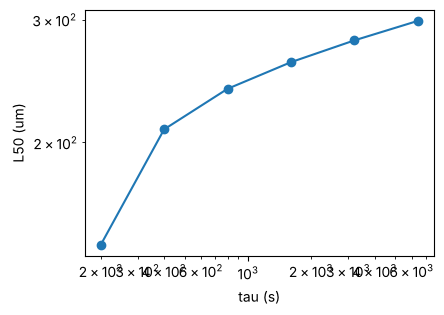
4. Residence time versus median size, by gradient#
With power-law kinetics \(G = k_g\Delta C^g\), \(B_0 = k_b M_T^j \Delta C^b\) the supersaturation \(\Delta C\) is the root of the solute balance closed with the third moment, so \(G\) itself depends on \(\tau\) and \(L_{50}(\tau) \neq 3.672\,G\tau\) at a fixed \(G\). The gradient comes from the implicit-function derivative of that root.
sol = Solubility.polynomial([0.35, 0.0075], hydrate_waters=10, solute_MW=142.0)      # synthetic
kin = (2.0e-6, 1.5, 1.0e9, 2.0, 0.6)                                                  # synthetic k_g, g, k_b, b, j
def run(t, kin=kin):
    return msmpr_steady_state(0.60, 1.0, K0 + 5.0, sol, kin, t, crystal_density=1460.0, liquor_density=1250.0)
taus = np.array([200.0, 400.0, 800.0, 1600.0, 3200.0, 6400.0])
L50 = np.array([float(run(t)["L_50"]) for t in taus]) * 1e6
dL = np.array([float(jax.grad(lambda t: run(t)["L_50"] * 1e6)(t)) for t in taus])
dC = np.array([float(run(t)["delta_C"]) for t in taus])
for t, l, d, c in zip(taus, L50, dL, dC):
    print(f"tau = {t:6.0f} s  dC = {c:.3e}  L50 = {l:7.1f} um  dL50/dtau = {d:.4f} um/s")
fig, ax = plt.subplots(figsize=(4.5, 3.2)); ax.loglog(taus, L50, "o-"); ax.set_xlabel("tau (s)"); ax.set_ylabel("L50 (um)"); plt.show()
h = 1e-3 * 800.0
print("gradient vs finite difference at tau = 800 s:", dL[2], (float(run(800 + h)["L_50"]) - float(run(800 - h)["L_50"])) * 1e6 / (2 * h))
eq = float(crystal_yield(0.60, 1.0, K0 + 5.0, sol))
print("k_g -> infinity approaches the equilibrium yield:",
      [f"{abs(float(run(900.0, (kg,) + kin[1:])['crystals']) - eq) / eq:.1e}" for kg in (1e-4, 1e-2, 1.0, 1e3, 1e6, 1e12)])
tau =    200 s  dC = 2.113e-01  L50 =   142.7 um  dL50/dtau = 0.6576 um/s
tau =    400 s  dC = 1.716e-01  L50 =   208.8 um  dL50/dtau = 0.1411 um/s
tau =    800 s  dC = 1.182e-01  L50 =   238.7 um  dL50/dtau = 0.0438 um/s
tau =   1600 s  dC = 7.894e-02  L50 =   260.6 um  dL50/dtau = 0.0183 um/s
tau =   3200 s  dC = 5.217e-02  L50 =   280.1 um  dL50/dtau = 0.0085 um/s
tau =   6400 s  dC = 3.430e-02  L50 =   298.6 um  dL50/dtau = 0.0042 um/s
gradient vs finite difference at tau = 800 s: 0.0438133589425061 0.04381338731942531
k_g -> infinity approaches the equilibrium yield: ['4.4e-02', '5.1e-03', '6.0e-04', '2.5e-05', '1.0e-06', '1.7e-09']
5. The unit in a flowsheet#
An Evaporator concentrate goes into a cooling Crystallizer; the mother liquor recycles to the evaporator.
from difflow import Evaporator, EvaporatorParams, Mixer
from difflow.flowsheet import Flowsheet, Unit
evap = Evaporator(EvaporatorParams(solute_species=["Na2SO4"], solute_MW=[142.0], solvent="water", x_product=0.30,
                                   bpr_model="ideal", vant_hoff_i=3.0, P_vapor_space=60e3, steam_P=300e3, U=1500.0))
xtal = Crystallizer(CrystallizerParams(solute="Na2SO4", solute_MW=142.0, solvent="water", T=278.15,
                                       solubility_coeffs=[0.35, 0.0075], hydrate_waters=10.0))
fresh = make_stream({"Na2SO4": 0.30 * 1000 / 142.0, "water": 1.7 * 1000 / 18.015}, T=313.15, P=1e5)
fs = Flowsheet(species_order=["water", "Na2SO4"])
fs.add_feed("feed", fresh)
fs.add_unit(Unit("mix", Mixer(["water", "Na2SO4"]), ["feed", "recycle"], ["evap_in"]))
fs.add_unit(Unit("evap", evap, ["evap_in"], ["conc", "vap"]))
fs.add_unit(Unit("xtal", xtal, ["conc"], ["crystals", "liquor"]))
fs.add_recycle("liquor", "recycle")
guess = {"recycle": make_stream({"Na2SO4": 0.5, "water": 40.0}, T=278.15, P=1e5)}
out = fs.solve(tear_initial=guess, tol=1e-12, max_iter=400, on_nonconvergence="raise")
print("crystals / fresh solute:", float(out["crystals"]["F_Na2SO4"] / fresh["F_Na2SO4"]))
print("bound water per solute :", float(out["crystals"]["F_water"] / out["crystals"]["F_Na2SO4"]))
crystals / fresh solute: 0.9999999999999948
bound water per solute : 10.0