
What is a Flowsheet? (Intermediate)#
Prerequisites: 00a_what_is_a_flowsheet_basic
Learning Objectives:
Understand flowsheets as systems of equations
See how streams act as shared variables between units
Learn about degrees of freedom analysis
Connect the equation view to simulation
From Pictures to Equations#
In the basic tutorial, we saw flowsheets as pictures with boxes and arrows. Now we’ll see them as systems of equations.
Every flowsheet simulation is really just solving equations. The question is: what equations?
The Mass Balance Equation#
The fundamental equation of chemical engineering is the mass balance:
For steady-state operation (no accumulation):
Or rearranged:
This applies to:
Total mass: Mass in = Mass out (for non-reactive systems)
Each species: Moles of species \(i\) in = Moles out + moles reacted
Energy: Energy in = Energy out + heat added/removed
Example: A Simple Mixer#
Let’s start with the simplest multi-stream unit: a mixer that combines two streams.
    Stream 1 ──────►┐
                    ├───► Stream 3 (mixed)
    Stream 2 ──────►┘
What equations describe this mixer?
For each species \(i\): $\(F_{3,i} = F_{1,i} + F_{2,i}\)$
For temperature (assuming ideal mixing with constant heat capacity): $\(F_3 \cdot T_3 = F_1 \cdot T_1 + F_2 \cdot T_2\)$
where \(F_j = \sum_i F_{j,i}\) is the total molar flow of stream \(j\).
Let’s implement this mathematically.
# Setup
import jax.numpy as jnp
import jax
jax.config.update("jax_enable_x64", True)

from difflow import make_stream, get_flows, combine_streams, total_flow
WARNING:2026-01-10 21:03:27,278:jax._src.xla_bridge:852: An NVIDIA GPU may be present on this machine, but a CUDA-enabled jaxlib is not installed. Falling back to cpu.
# Define the mixer equations explicitly

def mixer_equations(stream1, stream2):
    """
    Solve the mixer equations:
        F3_i = F1_i + F2_i  (for each species)
        T3 = (F1*T1 + F2*T2) / F3  (energy balance, assuming same Cp)
        P3 = min(P1, P2)  (take lower pressure)
    """
    # Mass balances - one equation per species
    flows1 = get_flows(stream1)
    flows2 = get_flows(stream2)

    mixed_flows = {}
    for species in flows1:
        # This IS the equation: F3_i = F1_i + F2_i
        mixed_flows[species] = flows1[species] + flows2[species]

    # Energy balance - simplified (assumes same Cp for all)
    F1_total = sum(flows1.values())
    F2_total = sum(flows2.values())
    F3_total = F1_total + F2_total

    # T3 from: F1*Cp*T1 + F2*Cp*T2 = F3*Cp*T3
    # Canceling Cp: T3 = (F1*T1 + F2*T2) / F3
    T3 = (F1_total * stream1['T'] + F2_total * stream2['T']) / F3_total

    # Pressure - take minimum (can't increase by mixing)
    P3 = jnp.minimum(stream1['P'], stream2['P'])

    return make_stream(mixed_flows, T=T3, P=P3)


# Create two inlet streams
stream1 = make_stream({'A': 10.0, 'B': 5.0}, T=300.0, P=200000.0)
stream2 = make_stream({'A': 5.0, 'B': 15.0}, T=350.0, P=180000.0)

# Solve the mixer equations
stream3 = mixer_equations(stream1, stream2)

print("Mixer Example")
print("=" * 50)
print("\nStream 1 (inlet):")
print(f"  F_A = {float(get_flows(stream1)['A']):.1f} mol/s")
print(f"  F_B = {float(get_flows(stream1)['B']):.1f} mol/s")
print(f"  T = {float(stream1['T']):.1f} K")

print("\nStream 2 (inlet):")
print(f"  F_A = {float(get_flows(stream2)['A']):.1f} mol/s")
print(f"  F_B = {float(get_flows(stream2)['B']):.1f} mol/s")
print(f"  T = {float(stream2['T']):.1f} K")

print("\nStream 3 (outlet - computed from equations):")
print(f"  F_A = {float(get_flows(stream3)['A']):.1f} mol/s  (= 10 + 5)")
print(f"  F_B = {float(get_flows(stream3)['B']):.1f} mol/s  (= 5 + 15)")
print(f"  T = {float(stream3['T']):.1f} K  (flow-weighted average)")
Mixer Example
==================================================

Stream 1 (inlet):
  F_A = 10.0 mol/s
  F_B = 5.0 mol/s
  T = 300.0 K

Stream 2 (inlet):
  F_A = 5.0 mol/s
  F_B = 15.0 mol/s
  T = 350.0 K

Stream 3 (outlet - computed from equations):
  F_A = 15.0 mol/s  (= 10 + 5)
  F_B = 20.0 mol/s  (= 5 + 15)
  T = 328.6 K  (flow-weighted average)
Counting Equations and Variables#
Let’s count what we have in the mixer:
Variables:
Stream 1: \(F_{1,A}\), \(F_{1,B}\), \(T_1\), \(P_1\) → 4 variables
Stream 2: \(F_{2,A}\), \(F_{2,B}\), \(T_2\), \(P_2\) → 4 variables
Stream 3: \(F_{3,A}\), \(F_{3,B}\), \(T_3\), \(P_3\) → 4 variables
Total: 12 variables
Equations from the mixer:
Mass balance for A: \(F_{3,A} = F_{1,A} + F_{2,A}\)
Mass balance for B: \(F_{3,B} = F_{1,B} + F_{2,B}\)
Energy balance: \(F_3 T_3 = F_1 T_1 + F_2 T_2\)
Pressure: \(P_3 = \min(P_1, P_2)\)
Total: 4 equations
Degrees of freedom: 12 - 4 = 8
This means we need to specify 8 values to solve the system. Typically, we specify all of streams 1 and 2 (8 values), and compute stream 3.
# Let's verify the degrees of freedom calculation

def count_stream_variables(stream):
    """Count variables in a stream."""
    n_species = len(get_flows(stream))
    return n_species + 2  # flows + T + P

def count_mixer_equations(n_species):
    """Count equations in a mixer."""
    # n_species mass balances + 1 energy balance + 1 pressure relation
    return n_species + 2

n_species = 2
n_streams = 3

total_vars = n_streams * (n_species + 2)
total_eqns = count_mixer_equations(n_species)
dof = total_vars - total_eqns

print("Degrees of Freedom Analysis - Mixer")
print("=" * 50)
print(f"Number of species: {n_species}")
print(f"Number of streams: {n_streams}")
print(f"Variables per stream: {n_species + 2} (flows + T + P)")
print(f"")
print(f"Total variables: {total_vars}")
print(f"Total equations: {total_eqns}")
print(f"Degrees of freedom: {dof}")
print(f"")
print(f"Interpretation: Specify {dof} values (e.g., both inlet streams)")
Degrees of Freedom Analysis - Mixer
==================================================
Number of species: 2
Number of streams: 3
Variables per stream: 4 (flows + T + P)

Total variables: 12
Total equations: 4
Degrees of freedom: 8

Interpretation: Specify 8 values (e.g., both inlet streams)
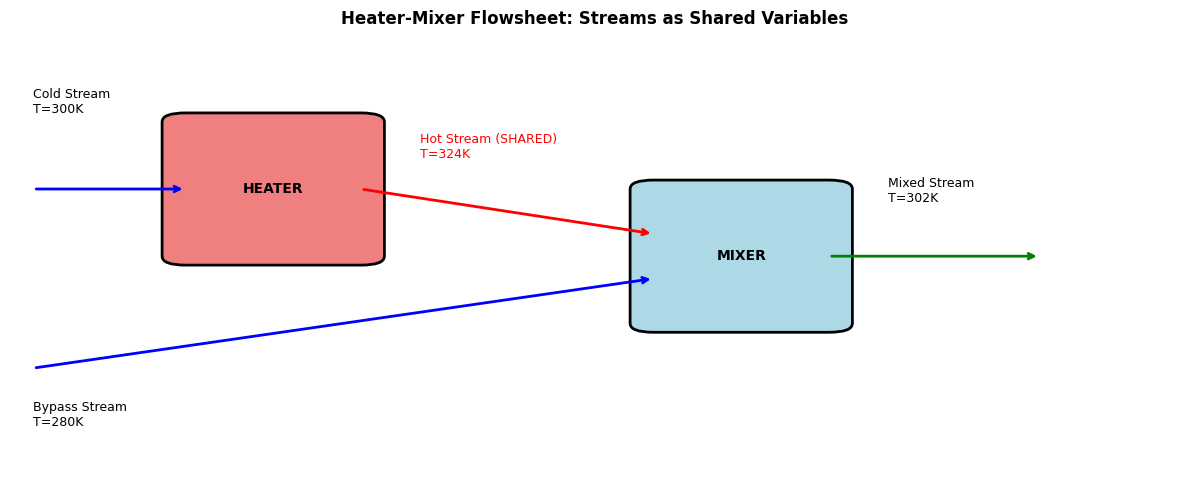
The Flowsheet as a System of Equations#
When we connect multiple units, we get a combined system of equations:
Heater equations:
\(F_{hot,A} = F_{cold,A}\) (no reaction)
\(F_{hot,B} = F_{cold,B}\) (no reaction)
\(Q = \sum_i F_{cold,i} C_{p,i} (T_{hot} - T_{cold})\) (energy balance)
Mixer equations:
\(F_{mix,A} = F_{hot,A} + F_{bypass,A}\)
\(F_{mix,B} = F_{hot,B} + F_{bypass,B}\)
\(F_{mix} T_{mix} = F_{hot} T_{hot} + F_{bypass} T_{bypass}\)
Shared variable: \(F_{hot,A}\), \(F_{hot,B}\), \(T_{hot}\) appear in both sets!
The computer solves ALL these equations together.
# Visualize the flowsheet with all stream data
import matplotlib.pyplot as plt
import matplotlib.patches as patches

def draw_heater_mixer_flowsheet(cold, hot, bypass, mixed, Q):
    fig, ax = plt.subplots(figsize=(12, 5))

    # Heater box: x=0.15-0.30, y=0.50-0.80
    heater_box = patches.FancyBboxPatch(
        (0.15, 0.50), 0.15, 0.30,
        boxstyle="round,pad=0.02",
        facecolor='lightcoral', edgecolor='black', linewidth=2
    )
    ax.add_patch(heater_box)
    ax.text(0.225, 0.65, 'HEATER', ha='center', va='center', fontsize=10, fontweight='bold')

    # Mixer box: x=0.55-0.70, y=0.35-0.65
    mixer_box = patches.FancyBboxPatch(
        (0.55, 0.35), 0.15, 0.30,
        boxstyle="round,pad=0.02",
        facecolor='lightblue', edgecolor='black', linewidth=2
    )
    ax.add_patch(mixer_box)
    ax.text(0.625, 0.5, 'MIXER', ha='center', va='center', fontsize=10, fontweight='bold')

    # Cold stream -> Heater (arrow ends at left edge of heater)
    ax.annotate('', xy=(0.15, 0.65), xytext=(0.02, 0.65),
                arrowprops=dict(arrowstyle='->', lw=2, color='blue'))
    ax.text(0.02, 0.82, f'Cold Stream\nT={float(cold["T"]):.0f}K', fontsize=9)

    # Heater -> Mixer (arrow starts at right edge of heater, ends at left edge of mixer)
    ax.annotate('', xy=(0.55, 0.55), xytext=(0.30, 0.65),
                arrowprops=dict(arrowstyle='->', lw=2, color='red'))
    ax.text(0.35, 0.72, f'Hot Stream (SHARED)\nT={float(hot["T"]):.0f}K', fontsize=9, color='red')

    # Bypass -> Mixer (arrow ends at left edge of mixer)
    ax.annotate('', xy=(0.55, 0.45), xytext=(0.02, 0.25),
                arrowprops=dict(arrowstyle='->', lw=2, color='blue'))
    ax.text(0.02, 0.12, f'Bypass Stream\nT={float(bypass["T"]):.0f}K', fontsize=9)

    # Mixer -> Product (arrow starts at right edge of mixer)
    ax.annotate('', xy=(0.88, 0.5), xytext=(0.70, 0.5),
                arrowprops=dict(arrowstyle='->', lw=2, color='green'))
    ax.text(0.75, 0.62, f'Mixed Stream\nT={float(mixed["T"]):.0f}K', fontsize=9)

    ax.set_xlim(0, 1)
    ax.set_ylim(0, 1)
    ax.axis('off')
    ax.set_title('Heater-Mixer Flowsheet: Streams as Shared Variables', fontsize=12, fontweight='bold')
    plt.tight_layout()
    return fig

fig = draw_heater_mixer_flowsheet(cold_stream, hot_stream, bypass_stream, mixed_stream, 20000.0)
Degrees of Freedom for Connected Systems#
When we connect units, the degrees of freedom analysis becomes:
The shared variables are counted ONCE, not twice.
For our heater-mixer system:
Heater: 8 variables (2 streams × 4) - 4 equations = 4 DOF
Mixer: 12 variables (3 streams × 4) - 4 equations = 8 DOF
Shared stream (hot): 4 variables
Combined: (8 + 12 - 4) variables - (4 + 4) equations = 16 - 8 = 8 DOF
We specify: cold stream (4), bypass stream (4), and heat duty (1) = 9 specifications. Wait, that’s 9, not 8! The extra one comes from the heater being over-specified if we give both Q and T_out.
# Let's verify by counting carefully

print("Degrees of Freedom Analysis - Connected System")
print("=" * 50)

# Variables
print("\nVARIABLES:")
print("  Cold stream: F_A, F_B, T, P  → 4")
print("  Hot stream:  F_A, F_B, T, P  → 4 (shared between heater and mixer)")
print("  Bypass stream: F_A, F_B, T, P → 4")
print("  Mixed stream: F_A, F_B, T, P → 4")
print("  Heat duty Q: 1")
print("  -------------------")
print("  Total: 17 variables")

# Equations
print("\nEQUATIONS:")
print("  Heater mass balance (A): F_hot_A = F_cold_A  → 1")
print("  Heater mass balance (B): F_hot_B = F_cold_B  → 1")
print("  Heater energy balance: Q = F*Cp*(T_hot - T_cold)  → 1")
print("  Heater pressure: P_hot = P_cold  → 1")
print("  Mixer mass balance (A): F_mix_A = F_hot_A + F_bypass_A  → 1")
print("  Mixer mass balance (B): F_mix_B = F_hot_B + F_bypass_B  → 1")
print("  Mixer energy balance: F_mix*T_mix = F_hot*T_hot + F_bypass*T_bypass  → 1")
print("  Mixer pressure: P_mix = min(P_hot, P_bypass)  → 1")
print("  -------------------")
print("  Total: 8 equations")

print("\nDEGREES OF FREEDOM: 17 - 8 = 9")
print("\nTo solve, we specify:")
print("  Cold stream: F_A, F_B, T, P  → 4 specs")
print("  Bypass stream: F_A, F_B, T, P → 4 specs")
print("  Heat duty Q: 1 spec")
print("  -------------------")
print("  Total: 9 specifications ✓")
Degrees of Freedom Analysis - Connected System
==================================================

VARIABLES:
  Cold stream: F_A, F_B, T, P  → 4
  Hot stream:  F_A, F_B, T, P  → 4 (shared between heater and mixer)
  Bypass stream: F_A, F_B, T, P → 4
  Mixed stream: F_A, F_B, T, P → 4
  Heat duty Q: 1
  -------------------
  Total: 17 variables

EQUATIONS:
  Heater mass balance (A): F_hot_A = F_cold_A  → 1
  Heater mass balance (B): F_hot_B = F_cold_B  → 1
  Heater energy balance: Q = F*Cp*(T_hot - T_cold)  → 1
  Heater pressure: P_hot = P_cold  → 1
  Mixer mass balance (A): F_mix_A = F_hot_A + F_bypass_A  → 1
  Mixer mass balance (B): F_mix_B = F_hot_B + F_bypass_B  → 1
  Mixer energy balance: F_mix*T_mix = F_hot*T_hot + F_bypass*T_bypass  → 1
  Mixer pressure: P_mix = min(P_hot, P_bypass)  → 1
  -------------------
  Total: 8 equations

DEGREES OF FREEDOM: 17 - 8 = 9

To solve, we specify:
  Cold stream: F_A, F_B, T, P  → 4 specs
  Bypass stream: F_A, F_B, T, P → 4 specs
  Heat duty Q: 1 spec
  -------------------
  Total: 9 specifications ✓
Why Degrees of Freedom Matter#
Understanding degrees of freedom helps you:
Know what to specify: DOF = number of values you must provide
Avoid over-specification: If DOF < 0, your system is inconsistent
Avoid under-specification: If DOF > 0, you can’t solve uniquely
Design experiments: Each measurement eliminates one DOF
In simulation software, you’ll often see errors like:
“System is over-specified” (too many constraints)
“System has no solution” (conflicting constraints)
“Multiple solutions exist” (under-specified)
Try It Yourself!#
Exercise 1: Count Degrees of Freedom#
A splitter divides one stream into two:
               ──► Stream 2
    Stream 1 ─┤
               ──► Stream 3
The split ratio \(\alpha\) defines the fraction going to stream 2.
Equations:
\(F_{2,i} = \alpha \cdot F_{1,i}\)
\(F_{3,i} = (1-\alpha) \cdot F_{1,i}\)
\(T_2 = T_3 = T_1\)
\(P_2 = P_3 = P_1\)
Count the variables, equations, and DOF for a 2-species system.
# Your analysis here
n_species = 2

# Variables:
# Stream 1: ?
# Stream 2: ?
# Stream 3: ?
# Split ratio alpha: ?
# Total: ?

# Equations:
# Mass balances stream 2: ?
# Mass balances stream 3: ?
# Temperature: ?
# Pressure: ?
# Total: ?

# DOF = ?

print("Your analysis:")
print(f"  Total variables: ?")
print(f"  Total equations: ?")
print(f"  DOF: ?")
Your analysis:
  Total variables: ?
  Total equations: ?
  DOF: ?
Exercise 2: Implement a Splitter#
def splitter_equations(inlet, alpha):
    """
    Split a stream into two based on split fraction alpha.

    Args:
        inlet: Input stream
        alpha: Fraction going to stream 2 (0 to 1)

    Returns:
        stream2, stream3: The two outlet streams
    """
    # Your code here
    # Hint: Use get_flows() and make_stream()
    pass

# Test it
# inlet = make_stream({'A': 100.0, 'B': 50.0}, T=350.0, P=200000.0)
# stream2, stream3 = splitter_equations(inlet, alpha=0.7)
# print(f"Stream 2: F_A = {get_flows(stream2)['A']} mol/s (should be 70)")
# print(f"Stream 3: F_A = {get_flows(stream3)['A']} mol/s (should be 30)")
Exercise 3: Connect Units#
Create a flowsheet with:
A feed stream
A splitter (70% to path A, 30% to path B)
A heater on path A (adds 10 kW)
A mixer that recombines both paths
Draw the flowsheet on paper first, then implement it.
# Your implementation here
End-of-Tutorial Problems#
Problem 1: Reactor Equations#
A reactor performs the reaction A → B with conversion \(X\).
Write the mass balance equations for this reactor in terms of:
Inlet flows: \(F_{A,in}\), \(F_{B,in}\)
Conversion: \(X\)
Outlet flows: \(F_{A,out}\), \(F_{B,out}\)
How many degrees of freedom does this reactor have?
Your answer here:
Problem 2: Flash Drum#
A flash drum separates a liquid feed into vapor and liquid products. The separation is governed by K-values:
where \(y_i\) is vapor mole fraction and \(x_i\) is liquid mole fraction.
List all the equations that govern a flash drum (mass balances, equilibrium relations, summation equations). How many equations are there for a 3-component system?
Your answer here:
Key Takeaways#
Flowsheets are systems of equations - Each unit contributes equations
Streams are shared variables - They connect units mathematically
Degrees of freedom = Variables - Equations - This tells you what to specify
Simulation = Solving equations - The computer finds values that satisfy all equations
Next Steps#
In the next notebook (00c: What is a Flowsheet? Advanced), we’ll explore:
Computational graphs and information flow
Sequential modular vs. equation-oriented approaches
Why recycles complicate everything