
Single Unit: Separators (Flash Drums)#
Prerequisites: 00d_single_unit_cstr, basic thermodynamics
Learning Objectives:
Understand vapor-liquid equilibrium (VLE)
Derive and solve the Rachford-Rice equation
Learn about K-values and their temperature/pressure dependence
Implement a flash drum calculation
What is a Flash Drum?#
A flash drum (or flash separator) is a vessel where a liquid mixture partially vaporizes:
                    ┌─────────────┐
                    │   Vapor (V) │──────► Light components
                    │             │
    Feed (F) ──────►│   ~~~~~~    │
                    │   ~~~~~~    │
                    │   Liquid (L)│──────► Heavy components
                    └─────────────┘
Key concept: Components with higher vapor pressure concentrate in the vapor; components with lower vapor pressure stay in the liquid.
Vapor-Liquid Equilibrium (VLE)#
At equilibrium, the chemical potential of each component is equal in both phases. For ideal systems, this leads to Raoult’s Law:
where:
\(y_i\) = vapor mole fraction
\(x_i\) = liquid mole fraction
\(P\) = system pressure
\(P_i^{sat}\) = saturation (vapor) pressure of pure component \(i\)
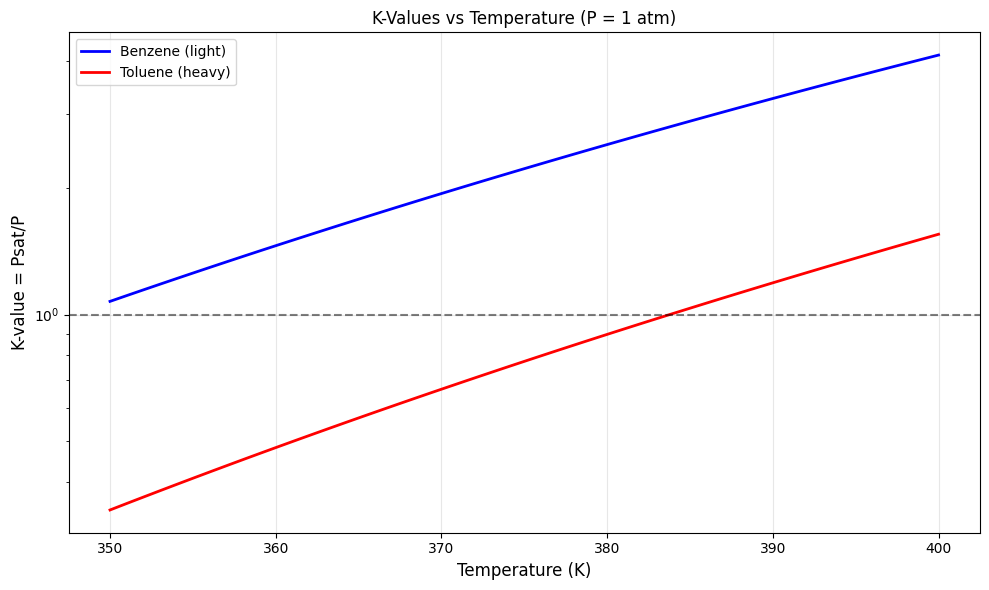
K-Values#
The K-value (equilibrium ratio) is defined as:
\(K_i > 1\): Component prefers vapor phase (“light” component)
\(K_i < 1\): Component prefers liquid phase (“heavy” component)
\(K_i = 1\): No preference
# Setup
import jax.numpy as jnp
import jax
jax.config.update("jax_enable_x64", True)
import matplotlib.pyplot as plt
import numpy as np

from difflow import Flash, FlashParams, make_stream, get_flows, IdealThermo, SpeciesData
WARNING:2026-01-10 21:08:47,715:jax._src.xla_bridge:852: An NVIDIA GPU may be present on this machine, but a CUDA-enabled jaxlib is not installed. Falling back to cpu.
# Define a binary mixture: benzene (light) and toluene (heavy)

species_data = {
    'benzene': SpeciesData(
        name='benzene', MW=78.0,
        Cp_coeffs=(135.0, 0, 0, 0),
        Hvap_coeffs=(30720.0, 0.38, 562.0),
        antoine_coeffs=(9.1058, 1211.0, -52.36),  # log10(Psat/Pa)
    ),
    'toluene': SpeciesData(
        name='toluene', MW=92.0,
        Cp_coeffs=(157.0, 0, 0, 0),
        Hvap_coeffs=(33180.0, 0.38, 592.0),
        antoine_coeffs=(9.0782, 1343.9, -53.77),
    ),
}
thermo = IdealThermo(species_data)

# Calculate K-values at different temperatures
T_range = np.linspace(350, 400, 50)
P = 101325.0  # 1 atm

K_benzene = []
K_toluene = []

for T in T_range:
    K_benzene.append(float(thermo.Psat('benzene', T)) / P)
    K_toluene.append(float(thermo.Psat('toluene', T)) / P)

# Plot K-values vs temperature
fig, ax = plt.subplots(figsize=(10, 6))
ax.plot(T_range, K_benzene, 'b-', linewidth=2, label='Benzene (light)')
ax.plot(T_range, K_toluene, 'r-', linewidth=2, label='Toluene (heavy)')
ax.axhline(y=1, color='k', linestyle='--', alpha=0.5)
ax.set_xlabel('Temperature (K)', fontsize=12)
ax.set_ylabel('K-value = Psat/P', fontsize=12)
ax.set_title('K-Values vs Temperature (P = 1 atm)', fontsize=12)
ax.legend()
ax.grid(True, alpha=0.3)
ax.set_yscale('log')
plt.tight_layout()
The Rachford-Rice Equation#
For a flash calculation, we know:
Feed composition \(z_i\)
Temperature \(T\) and pressure \(P\)
We want to find:
Vapor fraction \(V/F\) (what fraction vaporizes)
Vapor composition \(y_i\)
Liquid composition \(x_i\)
The Rachford-Rice equation combines material balances with VLE:
where \(\psi = V/F\) is the vapor fraction.
Once we solve for \(\psi\): $\(x_i = \frac{z_i}{1 + \psi(K_i - 1)}\)\( \)\(y_i = K_i x_i\)$
# Implement flash calculation from scratch

import optimistix as optx

def rachford_rice(psi, z, K):
    """
    Rachford-Rice equation: should equal zero at solution.

    Args:
        psi: Vapor fraction V/F
        z: Feed mole fractions (array)
        K: K-values (array)
    """
    return jnp.sum(z * (K - 1) / (1 + psi * (K - 1)))

def solve_flash_optimistix(z, K):
    """
    Solve flash using optimistix Newton solver on Rachford-Rice.

    JAX automatically computes the derivative for Newton's method.

    Returns:
        psi: Vapor fraction
        x: Liquid mole fractions
        y: Vapor mole fractions
    """
    def residual(psi, args):
        z, K = args
        return rachford_rice(psi, z, K)

    # Initial guess
    psi_init = jnp.array(0.5)

    # Create Newton solver - JAX computes the derivative automatically
    solver = optx.Newton(rtol=1e-10, atol=1e-10)

    # Solve the root-finding problem
    solution = optx.root_find(
        residual,
        solver,
        psi_init,
        args=(z, K),
        max_steps=50,
        throw=False,
    )

    psi = solution.value

    # Bound psi between 0 and 1 (physical constraint)
    psi = jnp.clip(psi, 0.0, 1.0)

    # Calculate compositions
    x = z / (1 + psi * (K - 1))
    y = K * x

    return float(psi), x, y

# Example: 50% benzene, 50% toluene at 370 K, 1 atm
z = jnp.array([0.5, 0.5])  # Equimolar feed
T = 370.0
P = 101325.0

K = jnp.array([float(thermo.Psat('benzene', T)) / P,
               float(thermo.Psat('toluene', T)) / P])

psi, x, y = solve_flash_optimistix(z, K)

print("Flash Calculation (From Scratch with optimistix)")
print("=" * 50)
print(f"Feed: z_benzene = {z[0]:.2f}, z_toluene = {z[1]:.2f}")
print(f"T = {T} K, P = {P/1000:.1f} kPa")
print(f"K-values: K_benzene = {float(K[0]):.3f}, K_toluene = {float(K[1]):.3f}")
print(f"")
print(f"Results:")
print(f"  Vapor fraction ψ = V/F = {psi:.4f}")
print(f"  Liquid: x_benzene = {float(x[0]):.4f}, x_toluene = {float(x[1]):.4f}")
print(f"  Vapor:  y_benzene = {float(y[0]):.4f}, y_toluene = {float(y[1]):.4f}")
Flash Calculation (From Scratch with optimistix)
==================================================
Feed: z_benzene = 0.50, z_toluene = 0.50
T = 370.0 K, P = 101.3 kPa
K-values: K_benzene = 1.939, K_toluene = 0.665

Results:
  Vapor fraction ψ = V/F = 0.9595
  Liquid: x_benzene = 0.2630, x_toluene = 0.7370
  Vapor:  y_benzene = 0.5100, y_toluene = 0.4900
# Using difflow's Flash

flash_params = FlashParams(species_order=['benzene', 'toluene'])
flash = Flash(flash_params, thermo=thermo)

# Create feed stream (10 mol/s total, equimolar)
feed = make_stream({'benzene': 5.0, 'toluene': 5.0}, T=350.0, P=P)

# Flash at 370 K
liquid, vapor, info = flash(feed, T=T, P=P)

print("\nFlash Calculation (difflow)")
print("=" * 50)
liquid_flows = get_flows(liquid)
vapor_flows = get_flows(vapor)

print(f"Feed: {float(get_flows(feed)['benzene']):.2f} mol/s benzene, "
      f"{float(get_flows(feed)['toluene']):.2f} mol/s toluene")
print(f"")
print(f"Liquid:")
print(f"  Benzene: {float(liquid_flows['benzene']):.4f} mol/s")
print(f"  Toluene: {float(liquid_flows['toluene']):.4f} mol/s")
print(f"")
print(f"Vapor:")
print(f"  Benzene: {float(vapor_flows['benzene']):.4f} mol/s")
print(f"  Toluene: {float(vapor_flows['toluene']):.4f} mol/s")
print(f"")
print(f"Vapor fraction: {float(info['V_frac']):.4f}")
Flash Calculation (difflow)
==================================================
Feed: 5.00 mol/s benzene, 5.00 mol/s toluene

Liquid:
  Benzene: 0.0655 mol/s
  Toluene: 0.1864 mol/s

Vapor:
  Benzene: 4.9347 mol/s
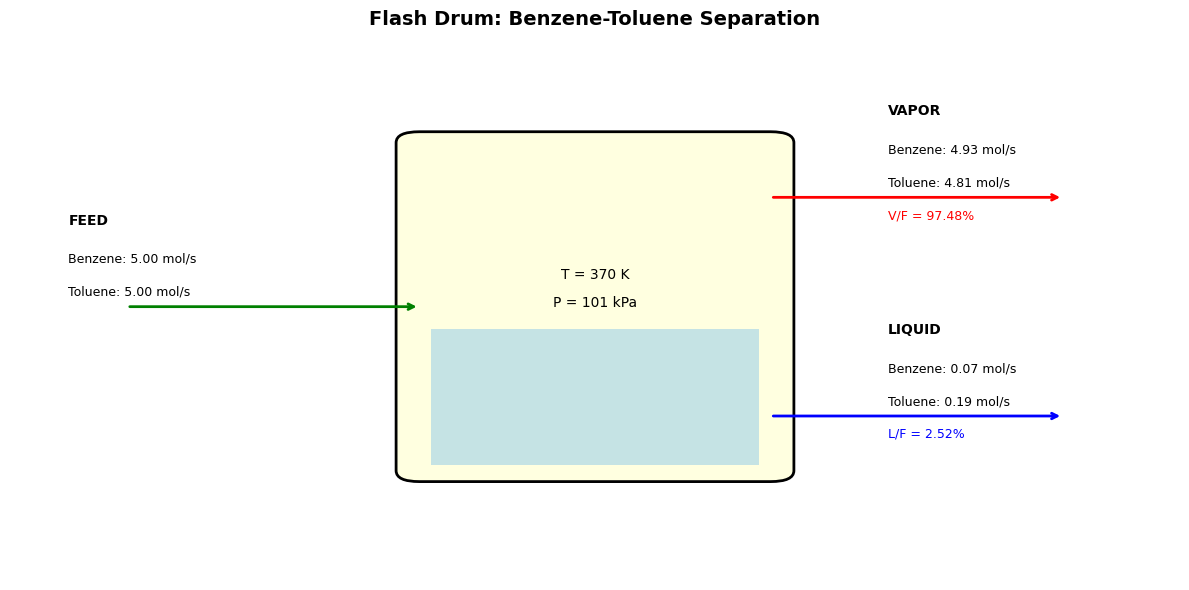
  Toluene: 4.8134 mol/s

Vapor fraction: 0.9748
Visualizing the Flash Operation#
import matplotlib.patches as patches

def draw_flash_diagram(feed_flows, liquid_flows, vapor_flows, T, P, vapor_frac):
    fig, ax = plt.subplots(figsize=(12, 6))

    # Flash drum
    drum = patches.FancyBboxPatch(
        (0.35, 0.2), 0.3, 0.6,
        boxstyle="round,pad=0.02",
        facecolor='lightyellow',
        edgecolor='black',
        linewidth=2,
    )
    ax.add_patch(drum)

    # Liquid level
    liquid_level = patches.Rectangle(
        (0.36, 0.21), 0.28, 0.25,
        facecolor='lightblue',
        alpha=0.7,
    )
    ax.add_patch(liquid_level)

    ax.text(0.5, 0.55, f'T = {T:.0f} K', ha='center', fontsize=10)
    ax.text(0.5, 0.50, f'P = {P/1000:.0f} kPa', ha='center', fontsize=10)

    # Feed arrow
    ax.annotate('', xy=(0.35, 0.5), xytext=(0.1, 0.5),
                arrowprops=dict(arrowstyle='->', lw=2, color='green'))
    ax.text(0.05, 0.65, 'FEED', fontsize=10, fontweight='bold')
    ax.text(0.05, 0.58, f'Benzene: {feed_flows[0]:.2f} mol/s', fontsize=9)
    ax.text(0.05, 0.52, f'Toluene: {feed_flows[1]:.2f} mol/s', fontsize=9)

    # Vapor arrow
    ax.annotate('', xy=(0.9, 0.7), xytext=(0.65, 0.7),
                arrowprops=dict(arrowstyle='->', lw=2, color='red'))
    ax.text(0.75, 0.85, 'VAPOR', fontsize=10, fontweight='bold')
    ax.text(0.75, 0.78, f'Benzene: {vapor_flows[0]:.2f} mol/s', fontsize=9)
    ax.text(0.75, 0.72, f'Toluene: {vapor_flows[1]:.2f} mol/s', fontsize=9)
    ax.text(0.75, 0.66, f'V/F = {vapor_frac:.2%}', fontsize=9, color='red')

    # Liquid arrow
    ax.annotate('', xy=(0.9, 0.3), xytext=(0.65, 0.3),
                arrowprops=dict(arrowstyle='->', lw=2, color='blue'))
    ax.text(0.75, 0.45, 'LIQUID', fontsize=10, fontweight='bold')
    ax.text(0.75, 0.38, f'Benzene: {liquid_flows[0]:.2f} mol/s', fontsize=9)
    ax.text(0.75, 0.32, f'Toluene: {liquid_flows[1]:.2f} mol/s', fontsize=9)
    ax.text(0.75, 0.26, f'L/F = {1-vapor_frac:.2%}', fontsize=9, color='blue')

    ax.set_xlim(0, 1)
    ax.set_ylim(0, 1)
    ax.axis('off')
    ax.set_title('Flash Drum: Benzene-Toluene Separation', fontsize=14, fontweight='bold')

    plt.tight_layout()
    return fig

fig = draw_flash_diagram(
    feed_flows=[5.0, 5.0],
    liquid_flows=[float(liquid_flows['benzene']), float(liquid_flows['toluene'])],
    vapor_flows=[float(vapor_flows['benzene']), float(vapor_flows['toluene'])],
    T=T, P=P,
    vapor_frac=float(info['V_frac'])
)
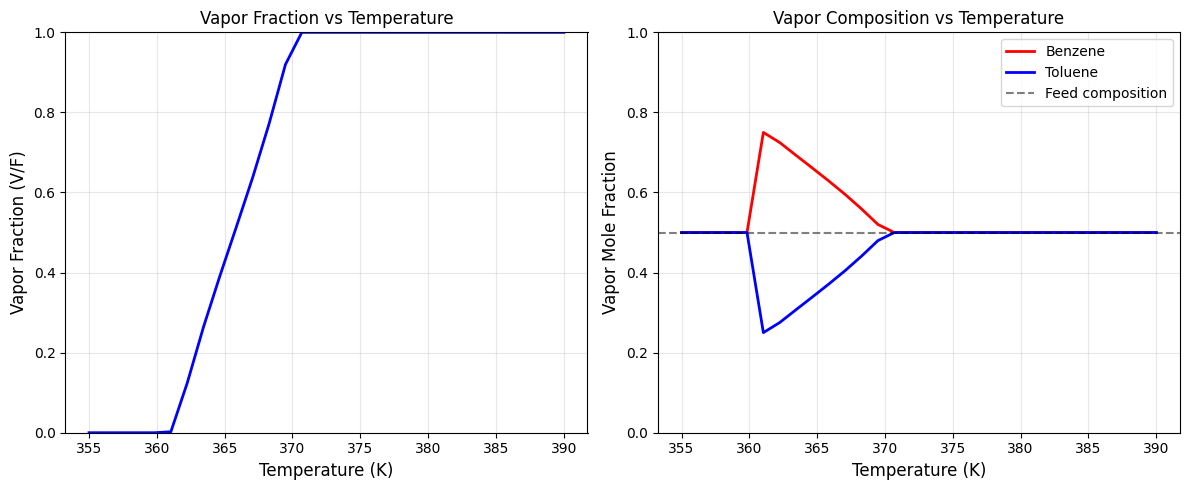
Effect of Temperature on Flash#
# How does vapor fraction change with temperature?

T_range = np.linspace(355, 390, 30)
vapor_fracs = []
y_benzene = []

for T_val in T_range:
    _, vapor, info = flash(feed, T=float(T_val), P=P)
    vapor_fracs.append(float(info['V_frac']))
    total_vapor = float(get_flows(vapor)['benzene']) + float(get_flows(vapor)['toluene'])
    if total_vapor > 0.01:
        y_benzene.append(float(get_flows(vapor)['benzene']) / total_vapor)
    else:
        y_benzene.append(0.5)  # Placeholder for no vapor

fig, axes = plt.subplots(1, 2, figsize=(12, 5))

# Left: Vapor fraction
ax = axes[0]
ax.plot(T_range, vapor_fracs, 'b-', linewidth=2)
ax.set_xlabel('Temperature (K)', fontsize=12)
ax.set_ylabel('Vapor Fraction (V/F)', fontsize=12)
ax.set_title('Vapor Fraction vs Temperature', fontsize=12)
ax.grid(True, alpha=0.3)
ax.set_ylim(0, 1)

# Right: Vapor composition
ax = axes[1]
ax.plot(T_range, y_benzene, 'r-', linewidth=2, label='Benzene')
ax.plot(T_range, [1-y for y in y_benzene], 'b-', linewidth=2, label='Toluene')
ax.axhline(y=0.5, color='k', linestyle='--', alpha=0.5, label='Feed composition')
ax.set_xlabel('Temperature (K)', fontsize=12)
ax.set_ylabel('Vapor Mole Fraction', fontsize=12)
ax.set_title('Vapor Composition vs Temperature', fontsize=12)
ax.legend()
ax.grid(True, alpha=0.3)
ax.set_ylim(0, 1)

plt.tight_layout()
Try It Yourself!#
Exercise 1: Pressure Effect#
Hold temperature constant at 370 K and vary pressure from 50 kPa to 150 kPa. How does vapor fraction change?
Exercise 2: Three-Component Flash#
Add a third component (e.g., xylene) and solve the flash. Does adding a heavier component increase or decrease the vapor fraction?
Exercise 3: Bubble Point#
Write a function to find the bubble point temperature (where V/F → 0) for a given mixture and pressure.
End-of-Tutorial Problems#
Problem 1: K-Value Calculation#
Using Antoine equation coefficients for hexane: A=9.002, B=1171.5, C=-48.8 (for log10(Psat/Pa)), calculate K at T=350K, P=101325 Pa.
Problem 2: Flash Design#
A feed of 100 mol/s (60% light, 40% heavy component) is flashed. K_light = 2.5, K_heavy = 0.4. Calculate the liquid and vapor flow rates and compositions.
Problem 3: Sharp Separation#
What K-value ratio (K_light/K_heavy) is needed to achieve 99% recovery of the light component in the vapor in a single flash?
Key Takeaways#
K-value: \(K_i = y_i/x_i = P_i^{sat}/P\) (for ideal systems)
Rachford-Rice: Nonlinear equation to find vapor fraction
Temperature effect: Higher T → more vapor, vapor enriched in light components
Pressure effect: Higher P → less vapor
Flash is a partial separation - distillation uses multiple stages for sharp separation
Next Steps#
In the next notebook (00h: Connecting Units in Series), we’ll:
Connect reactor + separator units
See how outlet streams become inlet streams
Build our first multi-unit flowsheet