
Connecting Units in Series#
Prerequisites: 00d-00g (single unit tutorials)
Learning Objectives:
Connect multiple units to form a flowsheet
See how outlet streams become inlet streams
Solve multi-unit systems sequentially
Build a reactor-separator process
From Single Units to Flowsheets#
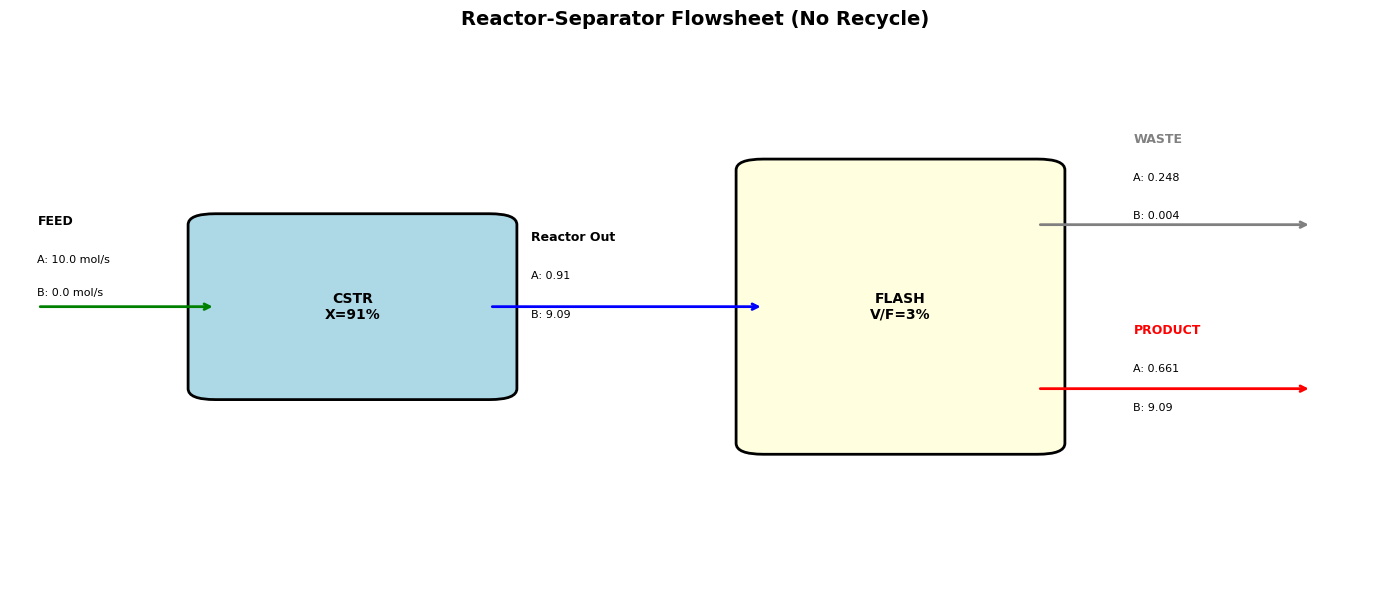
So far, we’ve solved individual units in isolation. Now we’ll connect them:
  Feed ──► Reactor ──► Separator ──► Product
                           │
                           └──► Waste
Key insight: The reactor’s outlet stream becomes the separator’s inlet stream. This is called stream sharing.
# Setup
import jax.numpy as jnp
import jax
jax.config.update("jax_enable_x64", True)
import matplotlib.pyplot as plt
import matplotlib.patches as patches

from difflow import (CSTR, CSTRParams, Flash, FlashParams,
                     make_stream, get_flows, IdealThermo, SpeciesData)
WARNING:2026-01-10 21:09:00,780:jax._src.xla_bridge:852: An NVIDIA GPU may be present on this machine, but a CUDA-enabled jaxlib is not installed. Falling back to cpu.
# Define species: A (reactant, light/volatile) -> B (product, heavy)

species_data = {
    'A': SpeciesData(
        name='A', MW=100.0,
        Cp_coeffs=(100.0, 0, 0, 0),
        Hvap_coeffs=(30000.0, 0.38, 450.0),
        antoine_coeffs=(10.0, 1500.0, -40.0),  # More volatile (lower B = higher Psat)
        Hf=0.0,
    ),
    'B': SpeciesData(
        name='B', MW=80.0,
        Cp_coeffs=(80.0, 0, 0, 0),
        Hvap_coeffs=(42000.0, 0.38, 550.0),
        antoine_coeffs=(10.0, 2400.0, -40.0),  # Less volatile (higher B = lower Psat)
        Hf=-50000.0,  # Exothermic reaction
    ),
}
thermo = IdealThermo(species_data)
species_order = ['A', 'B']

print("Process: A → B (first-order reaction)")
print("A is light (goes to vapor as waste), B is heavy (stays in liquid as product)")
Process: A → B (first-order reaction)
A is light (goes to vapor as waste), B is heavy (stays in liquid as product)
# Create unit operations

# Reactor: CSTR with first-order kinetics
def rate_fn(C, T, params):
    k = params['k']
    return jnp.array([k * C['A']])

stoich = jnp.array([[-1.0], [1.0]])  # A -> B

cstr_params = CSTRParams(
    V=jnp.array(2.0),  # 2 m³
    rate_fn=rate_fn,
    stoich=stoich,
    rate_params={'k': jnp.array(0.5)},
    species_order=species_order,
)
reactor = CSTR(cstr_params, thermo=thermo, mode='isothermal')

# Separator: Flash drum
flash_params = FlashParams(species_order=species_order)
flash = Flash(flash_params, thermo=thermo)

print("Units created:")
print("  - CSTR: V = 2 m³, k = 0.5 /s")
print("  - Flash drum")
Units created:
  - CSTR: V = 2 m³, k = 0.5 /s
  - Flash drum
Sequential Solution#
With no recycles, we can solve units in order:
Solve reactor: outlet = f(inlet, reactor params)
Solve flash: (liquid, vapor) = f(reactor outlet, flash params)
# Step 1: Define feed
feed = make_stream({'A': 10.0, 'B': 0.0}, T=350.0, P=101325.0)
Q_vol = 0.1  # m³/s volumetric flow

print("Step 1: Feed Stream")
print(f"  F_A = {float(get_flows(feed)['A']):.2f} mol/s")
print(f"  F_B = {float(get_flows(feed)['B']):.2f} mol/s")
print(f"  T = {float(feed['T']):.0f} K")
Step 1: Feed Stream
  F_A = 10.00 mol/s
  F_B = 0.00 mol/s
  T = 350 K
# Step 2: Solve reactor
reactor_out, reactor_info = reactor(feed, T_spec=350.0, volumetric_flow=Q_vol)

print("\nStep 2: Reactor Outlet (= Flash Inlet)")
print(f"  F_A = {float(get_flows(reactor_out)['A']):.4f} mol/s")
print(f"  F_B = {float(get_flows(reactor_out)['B']):.4f} mol/s")
print(f"  Conversion = {float(reactor_info['conversion']['A'])*100:.1f}%")
Step 2: Reactor Outlet (= Flash Inlet)
  F_A = 0.9091 mol/s
  F_B = 9.0909 mol/s
  Conversion = 90.9%
# Step 3: Solve flash (using reactor outlet as inlet)
# A is volatile (light), B is less volatile (heavy)
# Unreacted A goes to vapor (waste), product B stays in liquid (product)
# Use vacuum (10 kPa) to vaporize the volatile A impurity
liquid, vapor, flash_info = flash(reactor_out, T=350.0, P=10000.0)

print("\nStep 3: Flash Products")
print(f"\nVapor (Waste - unreacted A):")
print(f"  F_A = {float(get_flows(vapor)['A']):.4f} mol/s")
print(f"  F_B = {float(get_flows(vapor)['B']):.4f} mol/s")

print(f"\nLiquid (Product B):")
print(f"  F_A = {float(get_flows(liquid)['A']):.4f} mol/s")
print(f"  F_B = {float(get_flows(liquid)['B']):.4f} mol/s")

print(f"\nVapor fraction: {float(flash_info['V_frac'])*100:.1f}%")
Step 3: Flash Products

Vapor (Waste - unreacted A):
  F_A = 0.2481 mol/s
  F_B = 0.0043 mol/s

Liquid (Product B):
  F_A = 0.6610 mol/s
  F_B = 9.0866 mol/s

Vapor fraction: 2.5%
# Summary: Overall process performance
# Product B is in the LIQUID stream, waste A goes to VAPOR

F_A_feed = float(get_flows(feed)['A'])
F_B_product = float(get_flows(liquid)['B'])  # Product is in liquid
F_A_in_product = float(get_flows(liquid)['A'])  # Impurity in product
F_A_waste = float(get_flows(vapor)['A'])  # A vented as waste

overall_yield = F_B_product / F_A_feed
product_purity = F_B_product / (F_B_product + F_A_in_product) * 100

print("\n" + "=" * 50)
print("OVERALL PROCESS PERFORMANCE")
print("=" * 50)
print(f"Feed A:              {F_A_feed:.2f} mol/s")
print(f"Product B (liquid):  {F_B_product:.4f} mol/s")
print(f"Waste A (vapor):     {F_A_waste:.4f} mol/s")
print(f"")
print(f"Reactor conversion:  {float(reactor_info['conversion']['A'])*100:.1f}%")
print(f"Yield of B:          {overall_yield*100:.1f}%")
print(f"Product purity:      {product_purity:.1f}% B")
==================================================
OVERALL PROCESS PERFORMANCE
==================================================
Feed A:              10.00 mol/s
Product B (liquid):  9.0866 mol/s
Waste A (vapor):     0.2481 mol/s

Reactor conversion:  90.9%
Yield of B:          90.9%
Product purity:      93.2% B
Visualizing the Flowsheet#
def draw_reactor_separator_flowsheet(feed, reactor_out, liquid, vapor, reactor_conv, vapor_frac):
    fig, ax = plt.subplots(figsize=(14, 6))

    # Reactor
    reactor_box = patches.FancyBboxPatch(
        (0.15, 0.35), 0.2, 0.3,
        boxstyle="round,pad=0.02",
        facecolor='lightblue',
        edgecolor='black',
        linewidth=2,
    )
    ax.add_patch(reactor_box)
    ax.text(0.25, 0.5, f'CSTR\nX={reactor_conv*100:.0f}%', ha='center', va='center', fontsize=10, fontweight='bold')

    # Flash drum
    flash_box = patches.FancyBboxPatch(
        (0.55, 0.25), 0.2, 0.5,
        boxstyle="round,pad=0.02",
        facecolor='lightyellow',
        edgecolor='black',
        linewidth=2,
    )
    ax.add_patch(flash_box)
    ax.text(0.65, 0.5, f'FLASH\nV/F={vapor_frac*100:.0f}%', ha='center', va='center', fontsize=10, fontweight='bold')

    # Feed arrow
    ax.annotate('', xy=(0.15, 0.5), xytext=(0.02, 0.5),
                arrowprops=dict(arrowstyle='->', lw=2, color='green'))
    ax.text(0.02, 0.65, 'FEED', fontsize=9, fontweight='bold')
    ax.text(0.02, 0.58, f'A: {float(get_flows(feed)["A"]):.1f} mol/s', fontsize=8)
    ax.text(0.02, 0.52, f'B: {float(get_flows(feed)["B"]):.1f} mol/s', fontsize=8)

    # Reactor to Flash
    ax.annotate('', xy=(0.55, 0.5), xytext=(0.35, 0.5),
                arrowprops=dict(arrowstyle='->', lw=2, color='blue'))
    ax.text(0.38, 0.62, 'Reactor Out', fontsize=9, fontweight='bold')
    ax.text(0.38, 0.55, f'A: {float(get_flows(reactor_out)["A"]):.2f}', fontsize=8)
    ax.text(0.38, 0.48, f'B: {float(get_flows(reactor_out)["B"]):.2f}', fontsize=8)

    # Vapor waste (now at top - unreacted A)
    ax.annotate('', xy=(0.95, 0.65), xytext=(0.75, 0.65),
                arrowprops=dict(arrowstyle='->', lw=2, color='gray'))
    ax.text(0.82, 0.8, 'WASTE', fontsize=9, fontweight='bold', color='gray')
    ax.text(0.82, 0.73, f'A: {float(get_flows(vapor)["A"]):.3f}', fontsize=8)
    ax.text(0.82, 0.66, f'B: {float(get_flows(vapor)["B"]):.3f}', fontsize=8)

    # Liquid product (now at bottom - product B)
    ax.annotate('', xy=(0.95, 0.35), xytext=(0.75, 0.35),
                arrowprops=dict(arrowstyle='->', lw=2, color='red'))
    ax.text(0.82, 0.45, 'PRODUCT', fontsize=9, fontweight='bold', color='red')
    ax.text(0.82, 0.38, f'A: {float(get_flows(liquid)["A"]):.3f}', fontsize=8)
    ax.text(0.82, 0.31, f'B: {float(get_flows(liquid)["B"]):.2f}', fontsize=8)

    ax.set_xlim(0, 1)
    ax.set_ylim(0, 1)
    ax.axis('off')
    ax.set_title('Reactor-Separator Flowsheet (No Recycle)', fontsize=14, fontweight='bold')

    plt.tight_layout()
    return fig

fig = draw_reactor_separator_flowsheet(
    feed, reactor_out, liquid, vapor,
    float(reactor_info['conversion']['A']),
    float(flash_info['V_frac'])
)
Making it a Function#
Let’s wrap the entire flowsheet as a single function. This is the foundation for optimization!
def solve_reactor_separator(params, feed):
    """
    Solve the reactor-separator flowsheet.

    Product B is recovered in the LIQUID stream.
    Unreacted A is vented in the VAPOR stream.

    Args:
        params: dict with 'V_reactor', 'T_reactor', 'k', 'T_flash', 'P_flash', 'Q_vol'
        feed: Feed stream

    Returns:
        dict with all streams and performance metrics
    """
    # Unpack parameters
    V_reactor = params['V_reactor']
    T_reactor = params['T_reactor']
    k = params['k']
    T_flash = params['T_flash']
    P_flash = params.get('P_flash', jnp.array(10000.0))  # 10 kPa vacuum default
    Q_vol = params['Q_vol']

    # Create reactor
    cstr_p = CSTRParams(
        V=V_reactor,
        rate_fn=rate_fn,
        stoich=stoich,
        rate_params={'k': k},
        species_order=species_order,
    )
    reactor = CSTR(cstr_p, thermo=thermo, mode='isothermal')

    # Solve reactor
    reactor_out, reactor_info = reactor(feed, T_spec=float(T_reactor), volumetric_flow=float(Q_vol))

    # Solve flash - product B goes to liquid, waste A goes to vapor
    liquid, vapor, flash_info = flash(reactor_out, T=float(T_flash), P=float(P_flash))

    # Calculate metrics - product is in LIQUID
    F_A_feed = get_flows(feed)['A']
    F_B_product = get_flows(liquid)['B']  # Product B in liquid
    F_A_in_product = get_flows(liquid)['A']  # Impurity A in liquid

    # Purity of product stream
    purity = F_B_product / (F_B_product + F_A_in_product + 1e-10)

    return {
        'feed': feed,
        'reactor_out': reactor_out,
        'liquid': liquid,
        'vapor': vapor,
        'reactor_conversion': reactor_info['conversion']['A'],
        'vapor_fraction': flash_info['V_frac'],
        'product_B': F_B_product,
        'yield': F_B_product / F_A_feed,
        'purity': purity,
    }

# Test
params = {
    'V_reactor': jnp.array(2.0),
    'T_reactor': jnp.array(350.0),
    'k': jnp.array(0.5),
    'T_flash': jnp.array(350.0),
    'P_flash': jnp.array(10000.0),  # 10 kPa vacuum
    'Q_vol': jnp.array(0.1),
}

result = solve_reactor_separator(params, feed)
print(f"Yield of B: {float(result['yield'])*100:.1f}%")
print(f"Product purity: {float(result['purity'])*100:.1f}% B")
Yield of B: 90.9%
Product purity: 93.2% B
Effect of Operating Conditions#
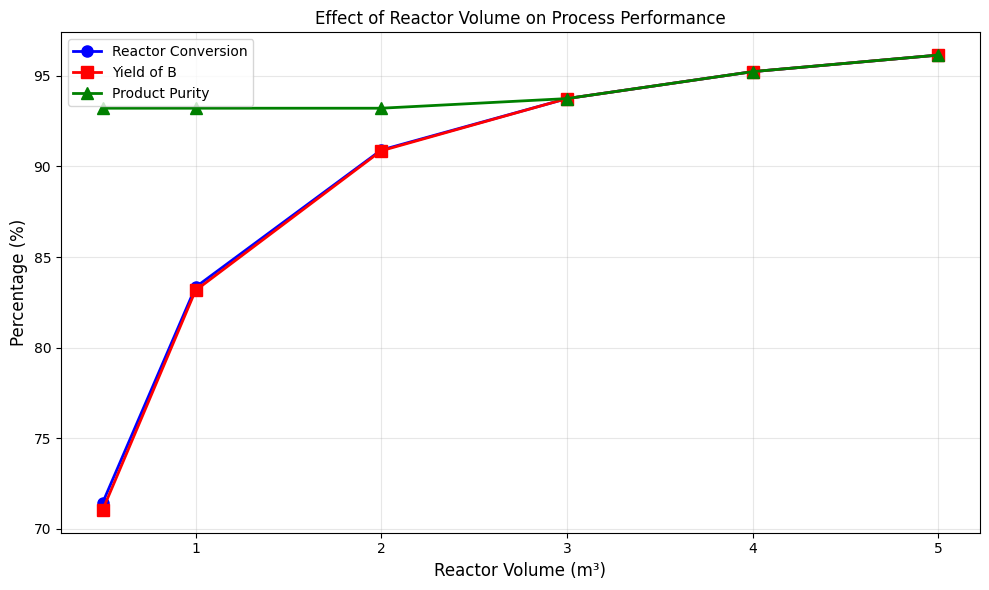
Now we can easily explore how parameters affect performance.
# How does reactor volume affect yield and purity?

volumes = [0.5, 1.0, 2.0, 3.0, 4.0, 5.0]
yields = []
purities = []
conversions = []

for V in volumes:
    params_test = {
        'V_reactor': jnp.array(V),
        'T_reactor': jnp.array(350.0),
        'k': jnp.array(0.5),
        'T_flash': jnp.array(350.0),
        'P_flash': jnp.array(10000.0),  # 10 kPa vacuum
        'Q_vol': jnp.array(0.1),
    }
    result = solve_reactor_separator(params_test, feed)
    yields.append(float(result['yield']))
    purities.append(float(result['purity']))
    conversions.append(float(result['reactor_conversion']))

fig, ax = plt.subplots(figsize=(10, 6))
ax.plot(volumes, [c*100 for c in conversions], 'b-o', linewidth=2, markersize=8, label='Reactor Conversion')
ax.plot(volumes, [y*100 for y in yields], 'r-s', linewidth=2, markersize=8, label='Yield of B')
ax.plot(volumes, [p*100 for p in purities], 'g-^', linewidth=2, markersize=8, label='Product Purity')
ax.set_xlabel('Reactor Volume (m³)', fontsize=12)
ax.set_ylabel('Percentage (%)', fontsize=12)
ax.set_title('Effect of Reactor Volume on Process Performance', fontsize=12)
ax.legend()
ax.grid(True, alpha=0.3)
plt.tight_layout()
Try It Yourself!#
Exercise 1: Temperature Effect#
How does flash temperature affect the purity of product B in the vapor stream?
Exercise 2: Add a Heater#
Add a heater between the reactor and flash to increase the flash temperature. Does this improve separation?
Exercise 3: Multiple Reactors#
Replace the single CSTR with two CSTRs in series (each half the original volume). Does this improve conversion?
End-of-Tutorial Problems#
Problem 1#
For the reactor-separator process, calculate the minimum reactor volume needed to achieve 90% overall conversion (not reactor conversion, but process conversion including separation).
Problem 2#
If the unreacted A in the liquid has value (can be sold), at what price does it become better to use a smaller reactor (more waste but lower capital cost)?
Problem 3#
Design a process with a heater between reactor and flash that maximizes yield while keeping flash temperature below 400 K.
Key Takeaways#
Stream sharing: One unit’s outlet = another unit’s inlet
Sequential solution: For DAGs, solve units in order
Wrap as function: Enables parametric studies and optimization
Process metrics: Overall yield ≠ reactor conversion (separation matters!)
Next Steps#
In the next notebook (00i: Parallel and Bypass Configurations), we’ll explore:
Splitters and mixers
Parallel processing paths
Bypass streams for temperature control