
The Saturated Gas Plant#
A crude unit’s overhead makes two streams that are not yet products:
a small offgas at near-atmospheric pressure;
an unstabilised naphtha that still carries its propane and butanes.
The saturated gas plant turns them into products. It compresses the offgas, sweetens it, recovers its C3+ into the naphtha, stabilises the naphtha by taking the LPG off the top, and splits what is left into light and heavy naphtha. The C2- that remains is fuel gas.
This notebook runs that chain on the test crude used throughout difflow_refinery
(examples/35_refinery_cdu_planning.ipynb). Every column is a rigorous
GasPlantColumn: Naphtali-Sandholm MESH on Peng-Robinson, with O’Connell tray
efficiencies. The chain is:
the crude unit, with a partial condenser at 40 C;
a two-stage
GasCompressoron the offgas, which knocks out a condensate between stages;an
AmineTreateron the compressed gas;an
absorber_deethanizer, with the unstabilised naphtha as lean oil;a
debutanizer, which makes the LPG and the stabilised naphtha;a naphtha
splitter, which makes light and heavy naphtha.
The last section takes implicit-function gradients through the debutanizer, as a planning model would.
import time

import jax
jax.config.update("jax_enable_x64", True)
import jax.numpy as jnp
import numpy as np
import matplotlib.pyplot as plt
from IPython.display import Markdown, display
from tabulate import tabulate

import difflow_refinery as dr
from difflow_refinery import Assay, characterize
from difflow_refinery import column as cc
from difflow_refinery.gasplant import (
    AmineTreater, AmineTreaterParams, GasCompressor, GasCompressorParams, GasPlantColumn,
    absorber_deethanizer, debutanizer, fuel_gas, gas_plant_feed, lpg_quality, splitter)


def table(rows, headers, floatfmt=".4g"):
    display(Markdown(tabulate(rows, headers, tablefmt="github", floatfmt=floatfmt)))
1. The crude unit#
The crude and column are those of examples/35_refinery_cdu_planning.ipynb, with two
changes:
The light ends add ethane, isobutane and isopentane, so that the gas plant has something to separate (volume percent on crude, an illustrative assay rather than a measured one).
The partial condenser is held at 40 C by a stage-temperature spec. A cooling-water condenser runs at about that temperature, and it fixes how much of the C3/C4 leaves as gas and how much stays dissolved in the naphtha.
PCT = [0, 5, 10, 20, 30, 40, 50, 60, 70, 80, 90, 95, 100]
T_C = [-10, 60, 95, 150, 205, 260, 315, 370, 430, 500, 600, 680, 850]
assay = Assay(PCT, [t + 273.15 for t in T_C], sg=0.86,
              light_ends={"ethane": 0.05, "propane": 0.5, "isobutane": 0.3,
                          "n_butane": 1.0, "isopentane": 0.8, "n_pentane": 1.5})
BPD = 95_000.0
Vf = BPD * cc.BARREL / 86400.0
params = cc.CrudeColumnParams(
    n_stages=30, feed_stage=27, P_top=1.5e5, P_bottom=1.9e5, P_condenser=1.3e5,
    bottom_steam=150.0, steam_T=273.15 + 260.0, condenser="partial",
    side_products=(cc.SideProduct("kero", 9, 4, steam=40.0),
                   cc.SideProduct("diesel", 16, 4, steam=40.0),
                   cc.SideProduct("ago", 22, 3, steam=20.0)),
    pumparounds=(cc.Pumparound("pa1", 12, 10), cc.Pumparound("pa2", 19, 17)),
    specs=(cc.product_rate("naphtha", 0.20 * Vf), cc.product_rate("kero", 0.11 * Vf),
           cc.product_rate("diesel", 0.17 * Vf), cc.product_rate("ago", 0.05 * Vf),
           cc.pumparound_duty("pa1", 15e6), cc.pumparound_delta_t("pa1", 60.0),
           cc.pumparound_duty("pa2", 20e6), cc.pumparound_delta_t("pa2", 60.0),
           cc.overflash(0.05), cc.stage_temperature(0, 273.15 + 40.0)),
)
crude = characterize(assay)
t0 = time.time()
cdu = dr.CrudeUnit(assay, params).solve(BPD, T=273.15 + 240.0, P=6e5)
print(f"CDU converged: {bool(cdu.converged)} ({time.time() - t0:.0f} s)")

off = {k[2:]: float(v) for k, v in cdu.products["offgas"].items() if k.startswith("F_")}
nap = {k[2:]: float(v) for k, v in cdu.products["naphtha"].items() if k.startswith("F_")}
show = ["water", "ethane", "propane", "isobutane", "n_butane", "isopentane", "n_pentane"]
table([(n, off.get(n, 0.0), nap.get(n, 0.0)) for n in show]
      + [("cuts", sum(v for k, v in off.items() if k.startswith("pc")),
          sum(v for k, v in nap.items() if k.startswith("pc")))],
      ["component", "offgas (mol/s)", "naphtha (mol/s)"])
CDU converged: True (52 s)
| component | offgas (mol/s) | naphtha (mol/s) | |————-|——————|——————-| | water | 0.1607 | 0 | | ethane | 0.3243 | 0.7091 | | propane | 0.995 | 9.052 | | isobutane | 0.2073 | 4.867 | | n_butane | 0.5187 | 17.03 | | isopentane | 0.1438 | 11.95 | | n_pentane | 0.2084 | 22.69 | | cuts | 0.2699 | 205.6 |
2. The gas plant’s components#
gas_plant_feed puts the crude unit’s offgas and naphtha on the gas plant’s component
table. It calls gas_components on the crude’s own characterization: the real light ends
from the database, followed by the pseudocomponent cuts with their EOS constants.
It keeps only the cuts that the naphtha actually carries, here those above
min_fraction=1e-3 of it. The heavier cuts would add a column to every EOS call to carry
about 1e-4 of the feed, so their flow is folded into the heaviest cut that is kept, and the
helper reports how much it folded. Water is dropped: the overhead accumulator decants it.
Neither the assay nor the CDU says anything about sulfur. The offgas is therefore given an
assumed 2 mol % H2S (h2s={"offgas": 0.02}, mol per mol of the water-free offgas),
which is enough for the amine treater to have something to remove and for the H2S to be
followed through the plant. (For an assay with sulfur_wt, evolved_h2s gives a flow from
a sulfur balance instead; the fraction of the sulfur that evolves is still an assumption.)
LIGHT = ["hydrogen_sulfide", "ethane", "propane", "isobutane", "n_butane",
         "isopentane", "n_pentane"]
gp = gas_plant_feed(cdu.products, crude, LIGHT, min_fraction=1e-3,
                    h2s={"offgas": 0.02},                    # assumed, see above
                    T=313.15, P=1.3e5)
comps, cuts, flows = gp.components, gp.cuts, gp.flows
offgas, naphtha, H2S = gp["offgas"], gp["naphtha"], gp.h2s_mol["offgas"]
print("components:", ", ".join(comps.names))
print(f"folded into {gp.fold_into}: {float(gp.folded_fraction):.1e} of the naphtha")
print(f"dropped water: {sum(float(v) for d in gp.dropped_kg.values() for v in d.values()):.3f} kg/s; "
      f"mass change on the gas-plant table: {sum(float(v) for v in gp.mass_change.values()):+.1e} kg/s")
components: hydrogen_sulfide, ethane, propane, isobutane, n_butane, isopentane, n_pentane, pc01, pc02, pc03, pc04, pc05, pc06
folded into pc06: 1.2e-04 of the naphtha
dropped water: 0.003 kg/s; mass change on the gas-plant table: -4.0e-04 kg/s
3. Compression and amine treating#
The offgas leaves the accumulator at 1.3 bar. The absorber-deethanizer runs at 14.5 bar, so a two-stage compressor raises it. Each stage is followed by an intercooler at 40 C and a knock-out drum. This offgas is mostly C3/C4, and at 14.5 bar and 40 C almost all of it condenses: the vapor that reaches the amine is a few percent of what was compressed. The condensate goes to the deethanizer with the gas.
The amine treater removes a fixed 99 % of the H2S from the compressed vapor. The
treating chemistry is out of scope; difflow_cc has a rate-based contactor. The condensate
bypasses the treater, as it does in a plant, so its dissolved H2S goes forward. Here that is
most of the H2S.
comp = GasCompressor(GasCompressorParams(comps, outlet_P=14.5e5, n_stages=2))
gas, condensate, ci = comp(offgas)
sweet, acid, ai = AmineTreater(AmineTreaterParams())(gas)
table([("compressor power (kW)", f"{float(ci['power']) / 1e3:.1f}"),
       ("discharge T, stage 1 / 2 (C)", ", ".join(f"{t - 273.15:.0f}" for t in ci["discharge_T"])),
       ("vapor to amine (mol/s)", f"{float(jnp.sum(flows(gas))):.4f}"),
       ("condensate (mol/s)", f"{float(jnp.sum(flows(condensate))):.3f}"),
       ("H2S in / removed (mol/s)", f"{H2S:.4f} / {float(ai['removed']['hydrogen_sulfide']):.4f}")],
      ["", "value"])
| | value | |——————————|—————–| | compressor power (kW) | 17.8 | | discharge T, stage 1 / 2 (C) | 85, 91 | | vapor to amine (mol/s) | 0.0561 | | condensate (mol/s) | 2.665 | | H2S in / removed (mol/s) | 0.0533 / 0.0030 |
4. The absorber-deethanizer#
The sweet gas and the condensate are combined and enter tray 6 of a 20-tray column. The unstabilised naphtha is the lean oil: it enters on tray 1 and absorbs the C3+ from the gas as it goes down. The reboiler strips the C2- back out of the liquid. The overhead leaves without a condenser and is the fuel gas. The bottoms go to the debutanizer.
The spec is the C2- mole fraction in the bottoms, 0.2 %. It replaces the reboiler duty. The factory default is 0.5 %, but that is infeasible on this feed: about 290 mol/s of bottoms at 0.5 % would have to hold more C2- than the feeds bring in. A spec the trays cannot make fails to converge rather than returning a wrong answer, and the next cell prints how much C2- there is to put in the bottoms.
feed = {k: sweet[k] + condensate[k] for k in sweet if k.startswith("F_")}
feed.update(T=313.15, P=14.5e5)
lean = dict(naphtha, P=14.5e5)                     # pumped up to the absorber
c2 = [comps.names.index(n) for n in ("hydrogen_sulfide", "ethane")]
c2_in = float(jnp.sum(flows(feed)[jnp.asarray(c2)] + flows(lean)[jnp.asarray(c2)]))
print(f"C2- into the deethanizer: {c2_in:.3f} mol/s; 0.5 % of the bottoms would be about "
      f"{0.005 * float(jnp.sum(flows(feed) + flows(lean))):.2f} mol/s")

t0 = time.time()
deeth = GasPlantColumn(absorber_deethanizer(comps, n_trays=20, feed_tray=6, c2_in_bottoms=0.002))
fgas, deeth_btms, di = deeth(lean, feed)
o = di["outputs"]
print(f"converged: {bool(di['converged'])} ({time.time() - t0:.0f} s); "
      f"tray efficiency (O'Connell) {float(deeth.efficiency(deeth.theta(lean, feed)['feeds'])):.2f}")
table([("reboiler duty (MW)", f"{float(o['reboiler.duty']) / 1e6:.2f}"),
       ("top / bottom T (C)", f"{float(o['top.T']) - 273.15:.1f} / {float(o['bottom.T']) - 273.15:.1f}"),
       ("fuel gas (mol/s)", f"{float(o['overhead.mol']):.3f}"),
       ("C2- in bottoms (mol frac)", f"{float(o['bottoms.x.C2-']):.4f}")], ["", "value"])
C2- into the deethanizer: 1.084 mol/s; 0.5 % of the bottoms would be about 1.37 mol/s
converged: True (81 s); tray efficiency (O'Connell) 0.61
| | value | |—————————|————–| | reboiler duty (MW) | 8.41 | | top / bottom T (C) | 60.1 / 178.2 | | fuel gas (mol/s) | 0.568 | | C2- in bottoms (mol frac) | 0.0020 |
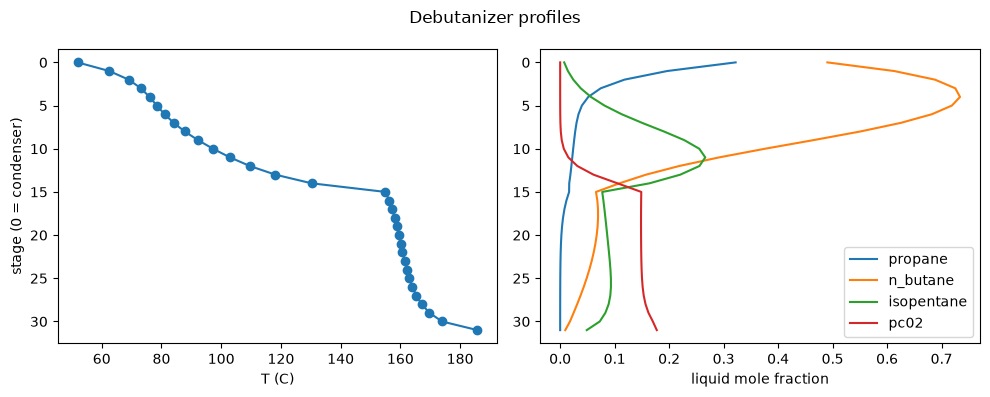
5. The debutanizer#
The deethanizer bottoms are let down to the debutanizer at 10 bar. It has 30 trays and a total condenser, and two specs:
1 % C5+ in the LPG, which replaces the distillate rate;
1 % C4 in the stabilised naphtha, which replaces the reboiler duty.
The naphtha’s RVP is the D323 construction on the EOS (vapor four times the liquid volume,
at 100 F), and it is reported as bottoms.rvp. The naphtha_rvp= spec puts a target on
it directly.
t0 = time.time()
debut = GasPlantColumn(debutanizer(comps, n_trays=30, feed_tray=15, c5_in_lpg=0.01,
                                   c4_in_naphtha=0.01))
lpg, stab, bi = debut(deeth_btms)
ob = bi["outputs"]
print(f"converged: {bool(bi['converged'])} ({time.time() - t0:.0f} s)")
q = lpg_quality(flows(lpg), comps, grade="commercial_propane")
table([("LPG (mol/s)", f"{float(ob['distillate.mol']):.2f}"),
       ("LPG propane / butanes+ (mol frac)",
        f"{float(q['values']['propane']):.3f} / {float(q['values']['butanes_plus']):.3f}"),
       ("LPG ethane- (mol frac)", f"{float(q['values']['ethane_minus']):.4f}"),
       ("LPG H2S (mol ppm)", f"{float(q['values']['h2s_ppm']):.0f}"),
       ("LPG vapor pressure at 100 F (kPa gauge)", f"{float(q['values']['vapor_pressure']) / 1e3:.0f}"),
       ("  margin to the commercial-propane limit (kPa)",
        f"{float(q['margins']['vapor_pressure']) / 1e3:.0f}"),
       ("stabilised naphtha RVP (kPa)", f"{float(ob['bottoms.rvp']) / 1e3:.1f}"),
       ("reboiler / condenser duty (MW)",
        f"{float(ob['reboiler.duty']) / 1e6:.2f} / {float(ob['condenser.duty']) / 1e6:.2f}")],
      ["", "value"])
converged: True (123 s)
| | value | |———————————————-|—————| | LPG (mol/s) | 31.09 | | LPG propane / butanes+ (mol frac) | 0.322 / 0.659 | | LPG ethane- (mol frac) | 0.0176 | | LPG H2S (mol ppm) | 1598 | | LPG vapor pressure at 100 F (kPa gauge) | 623 | | margin to the commercial-propane limit (kPa) | 811 | | stabilised naphtha RVP (kPa) | 32.9 | | reboiler / condenser duty (MW) | 4.11 / 4.24 |
This LPG is a mixed propane/butane stream. The only GPA 2140 limit it can sensibly be
held to is the commercial-propane vapor pressure, and it has a wide margin there. To meet
HD-5 propane it would need a C3/C4 splitter (c3c4_splitter) downstream.
The 1.8 % ethane is the C2- the deethanizer’s 0.2 % spec leaves in its bottoms, most of it brought in by the naphtha itself. A tighter spec, or more reboil, moves it to the fuel gas.
The H2S comes through for two reasons. The condensate bypassed the amine, and the deethanizer strips C2- but not all the H2S, whose volatility lies between ethane’s and propane’s. A real plant treats the LPG (caustic or Merox), which is out of scope here.
The GPA limits in GPA_2140 are flagged “verify” in the code. They were recalled, not
checked against an edition of the standard.
prof = bi["profiles"]
fig, ax = plt.subplots(1, 2, figsize=(10, 4))
stage = np.arange(len(prof["T"]))
ax[0].plot(np.asarray(prof["T"]) - 273.15, stage, "o-")
ax[0].set_xlabel("T (C)"); ax[0].set_ylabel("stage (0 = condenser)"); ax[0].invert_yaxis()
x = np.asarray(prof["x"])
for n in ("propane", "n_butane", "isopentane", "pc02"):
    ax[1].plot(x[:, comps.names.index(n)], stage, label=n)
ax[1].set_xlabel("liquid mole fraction"); ax[1].invert_yaxis(); ax[1].legend()
fig.suptitle("Debutanizer profiles"); fig.tight_layout()
6. The naphtha splitter#
The stabilised naphtha is split at 2.5 bar. It arrives at the debutanizer’s bottom temperature, so at 3 bar it is mostly vapor. That is why the splitter’s condenser duty is larger than its reboiler’s. The light key is placed between the first two cuts and the rest: the C5s and the first two cuts go overhead. Each product is held to 5 % of the other’s components.
t0 = time.time()
split = GasPlantColumn(splitter(comps, ("isopentane", "n_pentane") + tuple(cuts[:2]),
                                heavy_spec=("bottoms.x.light", 0.05),
                                light_spec=("distillate.x.heavy", 0.05),
                                n_trays=30, feed_tray=15, top_P=2.5e5))
lt_naphtha, hv_naphtha, si = split(dict(stab, P=3e5))
os_ = si["outputs"]
print(f"converged: {bool(si['converged'])} ({time.time() - t0:.0f} s)")
converged: True (68 s)
7. The plant in one table#
Every product, every duty, and the material balance across the whole chain.
The deethanizer’s reboiler is the largest duty. It heats the whole naphtha, entering as lean oil at 40 C, to about 180 C. Preheating the naphtha against the debutanizer feed would recover much of it. That is heat integration, which is out of scope here.
The balance is closed within each unit, so the products account for the feeds to round-off. This plant has no recycle: in a real plant the sponge oil and the stabilised naphtha recycled to the absorber would close a loop.
def mass(s):
    return float(jnp.sum(flows(s) * comps.MW)) * 3.6e-3  # g/s -> t/h


fg = fuel_gas(flows(fgas), comps)
rows = [("fuel gas", float(jnp.sum(flows(fgas))), mass(fgas), ""),
        ("acid gas (to sulfur recovery)", float(jnp.sum(flows(acid))), mass(acid), ""),
        ("LPG", float(jnp.sum(flows(lpg))), mass(lpg), ""),
        ("light naphtha", float(jnp.sum(flows(lt_naphtha))), mass(lt_naphtha),
         f"RVP {float(os_['distillate.rvp']) / 1e3:.0f} kPa" if "distillate.rvp" in os_ else ""),
        ("heavy naphtha", float(jnp.sum(flows(hv_naphtha))), mass(hv_naphtha), "")]
table(rows, ["product", "mol/s", "t/h", "note"])
print(f"fuel gas: LHV {float(fg['lhv_mass']) / 1e6:.1f} MJ/kg, {float(fg['heat']) / 1e6:.2f} MW, "
      f"H2S {float(fg['h2s_ppm']):.0f} ppm (mol)")

MW = lambda v: f"{float(v) / 1e6:.3f}"
table([("compressor", MW(ci["power"]), ""),
       ("deethanizer reboiler", MW(o["reboiler.duty"]), ""),
       ("debutanizer reboiler / condenser", MW(ob["reboiler.duty"]), MW(ob["condenser.duty"])),
       ("splitter reboiler / condenser", MW(os_["reboiler.duty"]), MW(os_["condenser.duty"]))],
      ["", "heat / power in (MW)", "heat out (MW)"])

into = flows(offgas) + flows(naphtha)
out = sum(flows(s) for s in (fgas, acid, lpg, lt_naphtha, hv_naphtha))
print(f"largest component imbalance across the plant: {float(jnp.max(jnp.abs(out - into))):.1e} mol/s "
      f"(on {float(jnp.sum(into)):.0f} mol/s)")
| product | mol/s | t/h | note | |——————————-|————|————|————| | fuel gas | 0.5681 | 0.07043 | | | acid gas (to sulfur recovery) | 0.003026 | 0.0003712 | | | LPG | 31.09 | 5.956 | | | light naphtha | 131.2 | 39.42 | RVP 57 kPa | | heavy naphtha | 111.7 | 45.39 | |
fuel gas: LHV 46.9 MJ/kg, 0.92 MW, H2S 1125 ppm (mol)
| | heat / power in (MW) | heat out (MW) | |———————————-|————————|—————–| | compressor | 0.018 | | | deethanizer reboiler | 8.405 | | | debutanizer reboiler / condenser | 4.105 | 4.238 | | splitter reboiler / condenser | 4.071 | 13.8 |
largest component imbalance across the plant: 5.5e-13 mol/s (on 275 mol/s)
8. Gradients through a column#
Each column solve ends with one Newton step at the converged Jacobian, so jax.grad
through solve_theta returns the implicit-function derivative. It does not differentiate
the iterations. gasplant_block uses this to build delta vectors for the planner.
Here are the debutanizer’s reboiler duty and the naphtha’s RVP as functions of the C4 left in the naphtha. This is the shift vector a planning model would use for “stabilise harder”.
th0 = debut.theta(deeth_btms)


def at_c4(c4):
    th = dict(th0, targets=dict(th0["targets"], **{"bottoms.x.C4": c4}))
    out = debut.solve_theta(th)["outputs"]
    return jnp.stack([out["reboiler.duty"], out["bottoms.rvp"], out["distillate.mol"]])


t0 = time.time()
J = jax.jacfwd(at_c4)(jnp.asarray(0.01))
h = 1e-4
fd = (at_c4(jnp.asarray(0.01 + h)) - at_c4(jnp.asarray(0.01 - h))) / (2 * h)
table([("reboiler duty (MW per mol frac)", float(J[0]) / 1e6, float(fd[0]) / 1e6),
       ("naphtha RVP (kPa per mol frac)", float(J[1]) / 1e3, float(fd[1]) / 1e3),
       ("LPG rate (mol/s per mol frac)", float(J[2]), float(fd[2]))],
      ["d/d(C4 in naphtha)", "implicit (AD)", "central FD"], floatfmt=".5g")
print(f"({time.time() - t0:.0f} s)")
| d/d(C4 in naphtha) | implicit (AD) | central FD | |———————————|—————–|————–| | reboiler duty (MW per mol frac) | -80.212 | -80.214 | | naphtha RVP (kPa per mol frac) | 302.75 | 302.75 | | LPG rate (mol/s per mol frac) | -248.19 | -248.19 |
(586 s)
Leaving more C4 in the naphtha costs less reboiler duty, raises its RVP and shrinks the LPG,
all as expected. The implicit and finite-difference derivatives agree to the digits
shown. tests/refinery/test_gasplant.py holds them to 1e-5 for the LPG purity, the naphtha
RVP and the reboiler duty, taken with respect to the reflux, the pressure and a feed
composition.
Where to go next#
docs/unit-operations-refinery.md(“The saturated gas plant”) has the column factories, the specs each one takes, and the gotchas.The IDAES cross-check is
tests/refinery/test_gasplant_validation.py. It compares the debutanizer and the C3/C4 splitter against IDAES’sTrayColumnon Peng-Robinson. That is an independent implementation of the same model, not an independent model.