
Implicit-Function Node: Recycle Streams and Algebraic Loops#
Equation-oriented process models routinely contain algebraic loops — a recycle stream whose flow depends on a reactor output that in turn depends on the recycle. Such a variable is defined only implicitly, as the solution of a square nonlinear system \(g(u, v) = 0\) with no closed form [Biegler, 2010].
discopt exposes these through m.implicit(...): a vector \(v\) defined by
\(g(u, v) = 0\) is compiled to a differentiable inner solve — a Newton iteration
for the forward map, and implicit-function-theorem derivatives for the
reverse, so the outer optimizer sees exact gradients without differentiating
through the Newton iterations [Blondel et al., 2022]. This is the core-side
primitive that lets reduced-space variable aggregation eliminate irreducible
cyclic blocks instead of leaving them in the model [Naik et al., 2025].
Note
An implicitly-defined \(\varphi(u)\) has no McCormick relaxation, so — like any
opaque AD-only node — a model containing m.implicit is solved on the local
NLP path only (no global optimality certificate), and integer variables are
rejected. It is a tool for local reduced-space solves, exactly the setting
where recycle loops arise.
import warnings

import jax.numpy as jnp
import numpy as np
import matplotlib.pyplot as plt

import discopt.modeling as dm

warnings.filterwarnings("ignore")
A reactor with recycle#
Fresh feed \(F_0\) of reactant A enters a mixer, joins a recycle stream \(R\), and passes through a reactor of volume \(V\). For a first-order reaction the single-pass conversion is \(X = kV / (T + kV)\), where \(T = F_0 + R\) is the total reactor feed, so the unreacted flow leaving is \(T\,(1 - X) = T^2/(T + kV)\). A separator returns a fraction \(\alpha\) of the unreacted A as recycle, \(R = \alpha\, T^2/(T + kV)\).
Substituting \(R = T - F_0\) closes the loop into a single implicit equation for the total reactor feed \(T\) given the design variable \(V\):
There is no explicit \(T(V)\) to substitute — this is precisely the irreducible
cyclic block that m.implicit handles.
The cell below prints a refusal on stderr before its results: “No valid dual bound
was produced … the result cannot be certified globally optimal.” That is the
expected behaviour, not a failure. An implicit node has no convex envelope, so the
relaxation layer has nothing to bound the objective with; the solver says so loudly
instead of returning a number that looks like a certificate. The model is solved on
the local NLP path, which is what gap_certified: False on the next line reports. We choose the reactor volume \(V\) to hit a
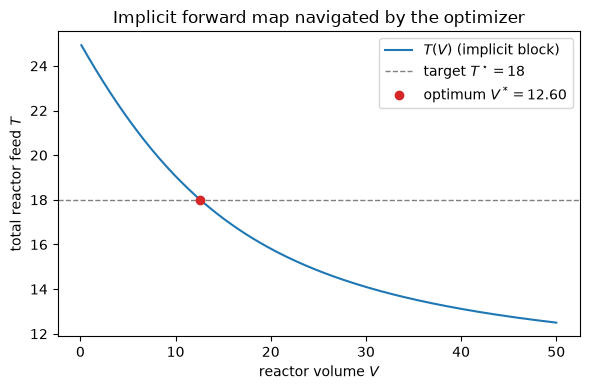
target throughput \(T^\star = 18\), minimizing \((T - T^\star)^2\).
F0, k, alpha = 10.0, 0.5, 0.6   # feed (mol/s), rate constant (1/s), recycle fraction
T_target = 18.0


def recycle_residual(u, v):
    # u = [V] (design), v = [T] (implicit unknown): g(T; V) = 0
    V, T = u[0], v[0]
    return jnp.array([(T - F0) * (T + k * V) - alpha * T**2])


m = dm.Model()
V = m.continuous("V", lb=0.1, ub=50.0)
T = m.implicit(recycle_residual, [V], n_unknowns=1, x0=jnp.array([20.0]))
m.minimize((T[0] - T_target) ** 2)

r = m.solve(initial_solution={V: 5.0})
print(f"status        : {r.status}")
print(f"V*            : {float(r.x['V']):.4f}")
print(f"objective     : {r.objective:.3e}")
print(f"gap_certified : {getattr(r, 'gap_certified', False)}   (local NLP path — no global cert)")
No valid dual bound was produced for model 'model': the relaxation layer could not bound this objective (status=feasible). The result cannot be certified globally optimal. A nonlinear term with no envelope is the usual cause; an epigraph reformulation (minimize z subject to f(x) <= z) often gives the relaxation something to bound.
status        : feasible
V*            : 12.6000
objective     : 3.187e-20
gap_certified : False   (local NLP path — no global cert)
The optimizer drove \(V\) using the derivative \(\mathrm{d}T/\mathrm{d}V\) that flows through the implicit solve by the implicit-function theorem, \(\mathrm{d}T/\mathrm{d}V = -(\partial g/\partial T)^{-1}\,(\partial g/\partial V)\) — no differentiation through the Newton iterations.
The forward map \(T(V)\)#
Because \(g\) is quadratic in \(T\) here, we can also write the root in closed form and use it to verify discopt’s answer and to visualize the block \(T(V)\) the optimizer navigated.
def T_of_V(Vval):
    # positive root of (1-alpha) T^2 + (kV - F0) T - F0 kV = 0
    a, b, c = (1 - alpha), (k * Vval - F0), -F0 * k * Vval
    return (-b + np.sqrt(b**2 - 4 * a * c)) / (2 * a)


Vstar = float(r.x["V"])
print(f"analytic V for T=18 : {(alpha * T_target**2 / (T_target - F0) - T_target) / k:.4f}")
print(f"discopt V*          : {Vstar:.4f}")
print(f"T(V*) check         : {T_of_V(Vstar):.4f}  (target {T_target})")

grid = np.linspace(0.1, 50, 200)
plt.figure(figsize=(6, 4))
plt.plot(grid, [T_of_V(v) for v in grid], label="$T(V)$ (implicit block)")
plt.axhline(T_target, ls="--", color="gray", lw=1, label="target $T^\star=18$")
plt.plot([Vstar], [T_of_V(Vstar)], "o", color="C3", label=f"optimum $V^*={Vstar:.2f}$")
plt.xlabel("reactor volume $V$")
plt.ylabel("total reactor feed $T$")
plt.legend()
plt.title("Implicit forward map navigated by the optimizer")
plt.tight_layout()
plt.show()
analytic V for T=18 : 12.6000
discopt V*          : 12.6000
T(V*) check         : 18.0000  (target 18.0)
The contract: local, and integer-free#
The node inherits discopt’s opaque-AD-only contract. Adding an integer variable to a model with an implicit block is rejected up front, because spatial branch-and-bound has no valid relaxation for \(\varphi(u)\):
m_bad = dm.Model()
Vb = m_bad.continuous("V", lb=0.1, ub=50.0)
m_bad.integer("stages", lb=1, ub=5)
Tb = m_bad.implicit(recycle_residual, [Vb], n_unknowns=1, x0=jnp.array([20.0]))
m_bad.minimize((Tb[0] - T_target) ** 2)

try:
    m_bad.solve()
except Exception as exc:
    print(f"rejected as expected: {type(exc).__name__}: {str(exc)[:90]}")
rejected as expected: ValueError: Model contains a dm.custom(...) AD-only user function that is OUTSIDE the sound reduced-sp
Takeaways#
m.implicit(residual, u_inputs, n_unknowns, x0=)represents a variable defined by a square system \(g(u, v) = 0\) as a differentiable inner solve.Forward: Newton with nonsingular-Jacobian and convergence gates (a failure surfaces as a failed evaluation rather than a wrong root). Reverse: exact implicit-function-theorem derivatives [Blondel et al., 2022].
It is local-NLP-only and rejects integers — the correct contract for an unrelaxable node, and the natural setting for recycle / algebraic-loop models [Biegler, 2010].
This is the primitive that enables implicit variable aggregation of cyclic blocks [Naik et al., 2025], shrinking tightly-coupled models the explicit, acyclic elimination cannot touch.