Transient diffusion - partial differential equations

| categories: pde | tags: mass transfer

We want to solve for the concentration profile of component that diffuses into a 1D rod, with an impermeable barrier at the end. The PDE governing this situation is:

\(\frac{\partial C}{\partial t} = D \frac{\partial^2 C}{\partial x^2}\)

at \(t=0\), in this example we have \(C_0(x) = 0\) as an initial condition, with boundary conditions \(C(0,t)=0.1\) and \(\partial C/ \partial x(L,t)=0\).

We are going to discretize this equation in both time and space to arrive at the solution. We will let \(i\) be the index for the spatial discretization, and \(j\) be the index for the temporal discretization. The discretization looks like this.
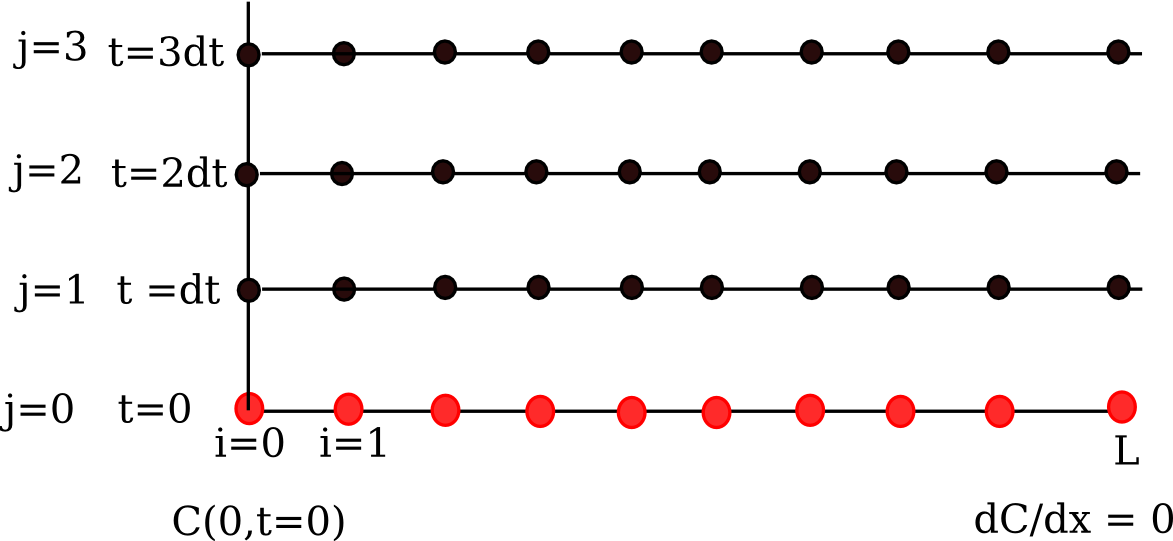
Note that we cannot use the method of lines as we did before because we have the derivative-based boundary condition at one of the boundaries.

We approximate the time derivative as:

\(\frac{\partial C}{\partial t} \bigg| _{i,j} \approx \frac{C_{i,j+1} - C_{i,j}}{\Delta t} \)

\(\frac{\partial^2 C}{\partial x^2} \bigg| _{i,j} \approx \frac{C_{i+1,j} - 2 C_{i,j} + C_{i-1,j}}{h^2} \)

We define \(\alpha = \frac{D \Delta t}{h^2}\), and from these two approximations and the PDE, we solve for the unknown solution at a later time step as:

\(C_{i, j+1} = \alpha C_{i+1,j} + (1 - 2 \alpha) C_{i,j} + \alpha C_{i-1,j} \)

We know \(C_{i,j=0}\) from the initial conditions, so we simply need to iterate to evaluate \(C_{i,j}\), which is the solution at each time step.

See also: http://www3.nd.edu/~jjwteach/441/PdfNotes/lecture16.pdf

import numpy as np
import matplotlib.pyplot as plt

N = 20  # number of points to discretize
L = 1.0
X = np.linspace(0, L, N) # position along the rod
h = L / (N - 1)          # discretization spacing

C0t = 0.1  # concentration at x = 0
D = 0.02

tfinal = 50.0
Ntsteps = 1000
dt = tfinal / (Ntsteps - 1)
t = np.linspace(0, tfinal, Ntsteps)

alpha = D * dt / h**2
print alpha

C_xt = [] # container for all the time steps

# initial condition at t = 0
C = np.zeros(X.shape)
C[0] = C0t

C_xt += [C]

for j in range(1, Ntsteps):
    N = np.zeros(C.shape)
    N[0] =  C0t
    N[1:-1] = alpha*C[2:] + (1 - 2 * alpha) * C[1:-1] + alpha * C[0:-2]
    N[-1] = N[-2]  # derivative boundary condition flux = 0
    C[:] = N
    C_xt += [N]

    # plot selective solutions
    if j in [1,2,5,10,20,50,100,200,500]:
        plt.plot(X, N, label='t={0:1.2f}'.format(t[j]))

plt.xlabel('Position in rod')
plt.ylabel('Concentration')
plt.title('Concentration at different times')
plt.legend(loc='best')
plt.savefig('images/transient-diffusion-temporal-dependence.png')

C_xt = np.array(C_xt)
plt.figure()
plt.plot(t, C_xt[:,5], label='x={0:1.2f}'.format(X[5]))
plt.plot(t, C_xt[:,10], label='x={0:1.2f}'.format(X[10]))
plt.plot(t, C_xt[:,15], label='x={0:1.2f}'.format(X[15]))
plt.plot(t, C_xt[:,19], label='x={0:1.2f}'.format(X[19]))
plt.legend(loc='best')
plt.xlabel('Time')
plt.ylabel('Concentration')
plt.savefig('images/transient-diffusion-position-dependence.png')

plt.show()
0.361361361361
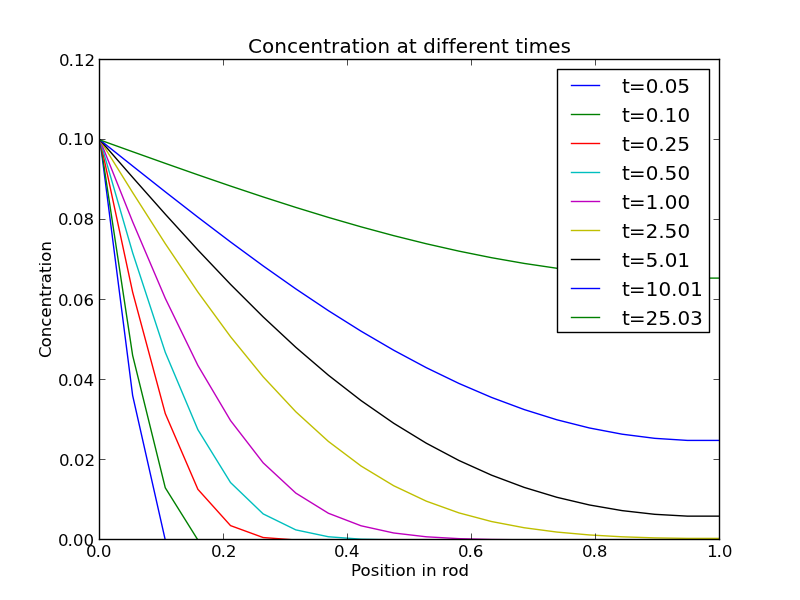
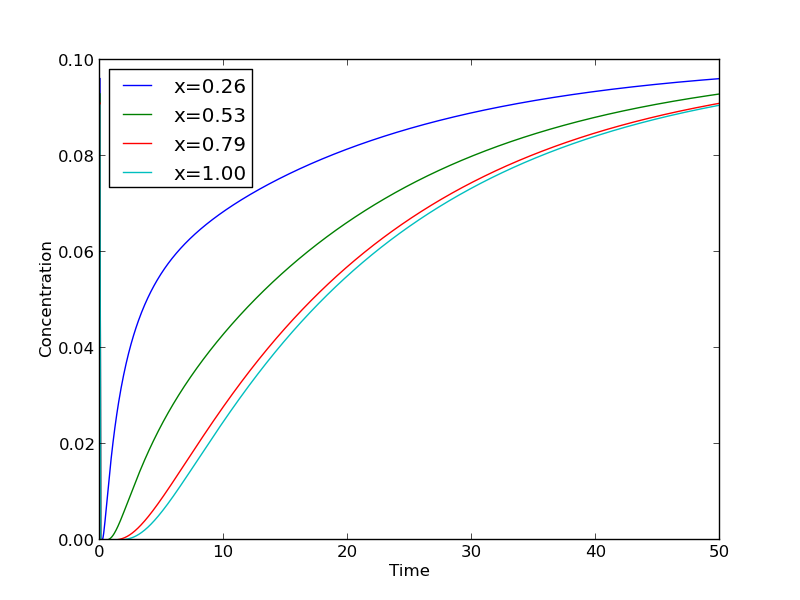
The solution is somewhat sensitive to the choices of time step and spatial discretization. If you make the time step too big, the method is not stable, and large oscillations may occur.

Copyright (C) 2013 by John Kitchin. See the License for information about copying.
org-mode source

Discuss on Twitter

Computing determinants from matrix decompositions

| categories: linear algebra | tags:

There are a few properties of a matrix that can make it easy to compute determinants.

  1. The determinant of a triangular matrix is the product of the elements on the diagonal.
  2. The determinant of a permutation matrix is (-1)**n where n is the number of permutations. Recall a permutation matrix is a matrix with a one in each row, and column, and zeros everywhere else.
  3. The determinant of a product of matrices is equal to the product of the determinant of the matrices.

The LU decomposition computes three matrices such that \(A = P L U\). Thus, \(\det A = \det P \det L \det U\). \(L\) and \(U\) are triangular, so we just need to compute the product of the diagonals. \(P\) is not triangular, but if the elements of the diagonal are not 1, they will be zero, and then there has been a swap. So we simply subtract the sum of the diagonal from the length of the diagonal and then subtract 1 to get the number of swaps.

import numpy as np
from scipy.linalg import lu

A = np.array([[6, 2, 3],
              [1, 1, 1],
              [0, 4, 9]])

P, L, U = lu(A)

nswaps = len(np.diag(P)) - np.sum(np.diag(P)) - 1

detP = (-1)**nswaps
detL =  np.prod(np.diag(L)) 
detU = np.prod(np.diag(U))

print detP * detL * detU

print np.linalg.det(A)
24.0
24.0

According to the numpy documentation, a method similar to this is used to compute the determinant.

Copyright (C) 2013 by John Kitchin. See the License for information about copying.
org-mode source

Discuss on Twitter

Handling units with dimensionless equations

| categories: units | tags:

As we have seen, handling units with third party functions is fragile, and often requires additional code to wrap the function to handle the units. An alternative approach that avoids the wrapping is to rescale the equations so they are dimensionless. Then, we should be able to use all the standard external functions without modification. We obtain the final solutions by rescaling back to the answers we want.

Before doing the examples, let us consider how the quantities package handles dimensionless numbers.

import quantities as u

a = 5 * u.m
L = 10 * u.m # characteristic length

print a/L
print type(a/L)
0.5 dimensionless
<class 'quantities.quantity.Quantity'>

As you can see, the dimensionless number is scaled properly, and is listed as dimensionless. The result is still an instance of a quantities object though. That is not likely to be a problem.

Now, we consider using fsolve with dimensionless equations. Our goal is to solve \(C_A = C_{A0} \exp(-k t)\) for the time required to reach a desired \(C_A\). We let \(X = Ca / Ca0\) and \(\tau = t * k\), which leads to \(X = \exp{-\tau}\) in dimensionless terms.

import quantities as u
import numpy as np
from scipy.optimize import fsolve

CA0 = 1 * u.mol / u.L
CA = 0.01 * u.mol / u.L  # desired exit concentration
k = 1.0 / u.s

# we need new dimensionless variables
# let X = Ca / Ca0
# so, Ca = Ca0 * X

# let tau = t * k
# so t = tau / k

X = CA / CA0 # desired exit dimensionless concentration

def func(tau):
    return X - np.exp(-tau)

tauguess = 2

print func(tauguess) # confirm we have a dimensionless function

tau_sol, = fsolve(func, tauguess)
t = tau_sol / k
print t
-0.125335283237 dimensionless
4.60517018599 s

Now consider the ODE \(\frac{dCa}{dt} = -k Ca\). We let \(X = Ca/Ca0\), so \(Ca0 dX = dCa\). Let \(\tau = t * k\) which in this case is dimensionless. That means \(d\tau = k dt\). Substitution of these new variables leads to:

\(Ca0*k \frac{dX}{d\tau} = -k Ca0 X \)

or equivalently: \(\frac{dX}{d\tau} = -X \)

import quantities as u

k = 0.23 / u.s
Ca0 = 1 * u.mol / u.L

# Let X = Ca/Ca0  -> Ca = Ca0 * X  dCa = dX/Ca0
# let tau = t * k -> dt = 1/k dtau


def dXdtau(X, tau):
    return -X

import numpy as np
from scipy.integrate import odeint

tspan = np.linspace(0, 5) * u.s
tauspan = tspan * k

X0 = 1
X_sol = odeint(dXdtau, X0, tauspan)

print 'Ca at t = {0} = {1}'.format(tspan[-1], X_sol.flatten()[-1] * Ca0)
Ca at t = 5.0 s = 0.316636777351 mol/L

That is pretty much it. Using dimensionless quantities simplifies the need to write wrapper code, although it does increase the effort to rederive your equations (with corresponding increased opportunities to make mistakes). Using units to confirm your dimensionless derivation reduces those opportunities.

Copyright (C) 2013 by John Kitchin. See the License for information about copying.

org-mode source

Discuss on Twitter

Two new MS theses completed

| categories: news | tags:

Congratulations to Zhizhong Ding and Vivek Vinodan who completed their MS theses!

Vivek's thesis was on “Modeling chemical looping processes”, and he was co-advised with Prof. Ydstie. Zhizhong's thesis was on “Ni-Fe-based oxygen carriers for chemical looping applications” and he was co-advised by Prof. Miller.

Copyright (C) 2013 by John Kitchin. See the License for information about copying.

org-mode source

Discuss on Twitter

Units in ODEs

| categories: odes, units | tags:

We reconsider a simple ODE but this time with units. We will use the quantities package again.

Here is the ODE, \(\frac{dCa}{dt} = -k Ca\) with \(C_A(0) = 1.0\) mol/L and \(k = 0.23\) 1/s. Compute the concentration after 5 s.

import quantities as u

k = 0.23 / u.s
Ca0 = 1 * u.mol / u.L

def dCadt(Ca, t):
    return -k * Ca

import numpy as np
from scipy.integrate import odeint

tspan = np.linspace(0, 5) * u.s

sol = odeint(dCadt, Ca0, tspan)

print sol[-1]
[ 0.31663678]

No surprise, the units are lost. Now we start wrapping odeint. We wrap everything, and then test two examples including a single ODE, and a coupled set of ODEs with mixed units.

import quantities as u
import matplotlib.pyplot as plt

import numpy as np
from scipy.integrate import odeint as _odeint

def odeint(func, y0, t, args=(),
           Dfun=None, col_deriv=0, full_output=0,
           ml=None, mu=None, rtol=None, atol=None,
           tcrit=None, h0=0.0, hmax=0.0, hmin=0.0,
           ixpr=0, mxstep=0, mxhnil=0, mxordn=12,
           mxords=5, printmessg=0):

    def wrapped_func(Y0, T, *args):
        # put units on T if they are on the original t
        # check for units so we don't put them on twice
        if not hasattr(T, 'units') and hasattr(t, 'units'):
            T = T * t.units
        # now for the dependent variable units. Y0 may be a scalar or
        # a list or an array. we want to check each element of y0 for
        # units, and add them to the corresponding element of Y0 if we
        # need to.
        try:
            uY0 = [x for x in Y0] # a list copy of contents of Y0
            # this works if y0 is an iterable, eg. a list or array
            for i, yi in enumerate(y0):
                if not hasattr(uY0[i],'units') and hasattr(yi, 'units'):
               
                    uY0[i] = uY0[i] * yi.units
                
        except TypeError:
            # we have a scalar
            if not hasattr(Y0, 'units') and hasattr(y0, 'units'):
                uY0 = Y0 * y0.units
       
        val = func(uY0, t, *args)

        try:
            return np.array([float(x) for x in val])
        except TypeError:
            return float(val)
    
    if full_output:
        y, infodict = _odeint(wrapped_func, y0, t, args,
                              Dfun, col_deriv, full_output,
                              ml, mu, rtol, atol,
                              tcrit, h0, hmax, hmin,
                              ixpr, mxstep, mxhnil, mxordn,
                              mxords, printmessg)
    else:
        y = _odeint(wrapped_func, y0, t, args,
                    Dfun, col_deriv, full_output,
                    ml, mu, rtol, atol,
                    tcrit, h0, hmax, hmin,
                    ixpr, mxstep, mxhnil, mxordn,
                    mxords, printmessg)

    # now we need to put units onto the solution units should be the
    # same as y0. We cannot put mixed units in an array, so, we return a list
    m,n = y.shape # y is an ndarray, so it has a shape
    if n > 1: # more than one equation, we need a list
        uY = [0 for yi in range(n)]
        
        for i, yi in enumerate(y0):
            if not hasattr(uY[i],'units') and hasattr(yi, 'units'):
                uY[i] = y[:,i] * yi.units
            else:
                uY[i] = y[:,i]
                
    else:
        uY = y * y0.units

    y = uY


    if full_output:
        return y, infodict
    else:
        return y

##################################################################
# test a single ODE
k = 0.23 / u.s
Ca0 = 1 * u.mol / u.L

def dCadt(Ca, t):
    return -k * Ca

tspan = np.linspace(0, 5) * u.s
sol = odeint(dCadt, Ca0, tspan)

print sol[-1]

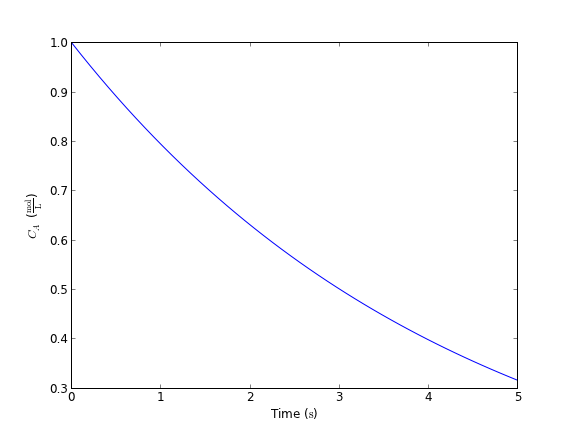
plt.plot(tspan, sol)
plt.xlabel('Time ({0})'.format(tspan.dimensionality.latex))
plt.ylabel('$C_A$ ({0})'.format(sol.dimensionality.latex))
plt.savefig('images/ode-units-ca.png')

##################################################################
# test coupled ODEs
lbmol = 453.59237*u.mol

kprime = 0.0266 * lbmol / u.hr / u.lb
Fa0 = 1.08 * lbmol / u.hr
alpha = 0.0166 / u.lb
epsilon = -0.15

def dFdW(F, W, alpha0):
    X, y = F
    dXdW = kprime / Fa0 * (1.0 - X)/(1.0 + epsilon * X) * y
    dydW = - alpha0 * (1.0 + epsilon * X) / (2.0 * y)
    return [dXdW, dydW]

X0 = 0.0 * u.dimensionless
y0 = 1.0

# initial conditions
F0 = [X0, y0] # one without units, one with units, both are dimensionless

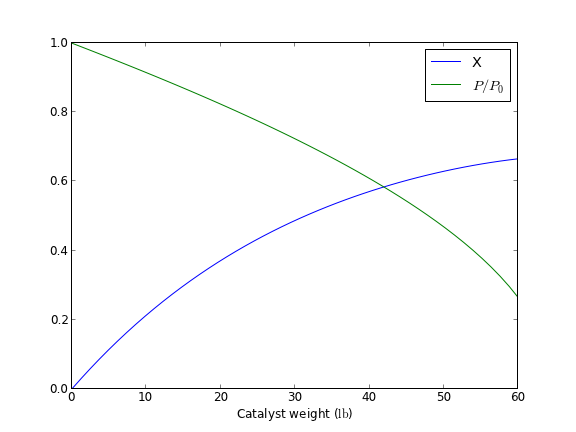
wspan = np.linspace(0,60) * u.lb

sol = odeint(dFdW, F0, wspan, args=(alpha,))
X, y = sol

print 'Test 2'
print X[-1]
print y[-1]

plt.figure()
plt.plot(wspan, X, wspan, y)
plt.legend(['X','$P/P_0$'])
plt.xlabel('Catalyst weight ({0})'.format(wspan.dimensionality.latex))
plt.savefig('images/ode-coupled-units-pdrpo.png')
[ 0.31663678] mol/L
Test 2
0.665569578156 dimensionless
0.263300470681

That is not too bad. This is another example of a function you would want to save in a module for reuse. There is one bad feature of the wrapped odeint function, and that is that it changes the solution for coupled ODEs from an ndarray to a list. That is necessary because you apparently cannot have mixed units in an ndarray. It is fine, however, to have a list of mixed units. This is not a huge problem, but it changes the syntax for plotting results for the wrapped odeint function compared to the unwrapped function without units.

Copyright (C) 2013 by John Kitchin. See the License for information about copying.

org-mode source

Discuss on Twitter
« Previous Page -- Next Page »