Plane poiseuelle flow solved by finite difference

| categories: bvp | tags: fluids

Matlab post

Adapted from http://www.physics.arizona.edu/~restrepo/475B/Notes/sourcehtml/node24.html

We want to solve a linear boundary value problem of the form: y'' = p(x)y' + q(x)y + r(x) with boundary conditions y(x1) = alpha and y(x2) = beta.

For this example, we solve the plane poiseuille flow problem using a finite difference approach. An advantage of the approach we use here is we do not have to rewrite the second order ODE as a set of coupled first order ODEs, nor do we have to provide guesses for the solution. We do, however, have to discretize the derivatives and formulate a linear algebra problem.

we want to solve u'' = 1/mu*DPDX with u(0)=0 and u(0.1)=0. for this problem we let the plate separation be d=0.1, the viscosity \(\mu = 1\), and \(\frac{\Delta P}{\Delta x} = -100\).

The idea behind the finite difference method is to approximate the derivatives by finite differences on a grid. See here for details. By discretizing the ODE, we arrive at a set of linear algebra equations of the form \(A y = b\), where \(A\) and \(b\) are defined as follows.

\[A = \left [ \begin{array}{ccccc} % 2 + h^2 q_1 & -1 + \frac{h}{2} p_1 & 0 & 0 & 0 \\ -1 - \frac{h}{2} p_2 & 2 + h^2 q_2 & -1 + \frac{h}{2} p_2 & 0 & 0 \\ 0 & \ddots & \ddots & \ddots & 0 \\ 0 & 0 & -1 - \frac{h}{2} p_{N-1} & 2 + h^2 q_{N-1} & -1 + \frac{h}{2} p_{N-1} \\ 0 & 0 & 0 & -1 - \frac{h}{2} p_N & 2 + h^2 q_N \end{array} \right ] \]

\[ y = \left [ \begin{array}{c} y_i \\ \vdots \\ y_N \end{array} \right ] \]

\[ b = \left [ \begin{array}{c} -h^2 r_1 + ( 1 + \frac{h}{2} p_1) \alpha \\ -h^2 r_2 \\ \vdots \\ -h^2 r_{N-1} \\ -h^2 r_N + (1 - \frac{h}{2} p_N) \beta \end{array} \right] \]

import numpy as np

# we use the notation for y'' = p(x)y' + q(x)y + r(x)
def p(x): return 0
def q(x): return 0
def r(x): return -100

#we use the notation y(x1) = alpha and y(x2) = beta

x1 = 0; alpha = 0.0
x2 = 0.1; beta = 0.0

npoints = 100

# compute interval width
h = (x2-x1)/npoints;

# preallocate and shape the b vector and A-matrix
b = np.zeros((npoints - 1, 1));
A = np.zeros((npoints - 1, npoints - 1));
X = np.zeros((npoints - 1, 1));

#now we populate the A-matrix and b vector elements
for i in range(npoints - 1):
    X[i,0] = x1 + (i + 1) * h

    # get the value of the BVP Odes at this x
    pi = p(X[i])
    qi = q(X[i])
    ri = r(X[i])

    if i == 0:
        # first boundary condition
        b[i] = -h**2 * ri + (1 + h / 2 * pi)*alpha; 
    elif i == npoints - 1:
        # second boundary condition
        b[i] = -h**2 * ri + (1 - h / 2 * pi)*beta; 
    else:
        b[i] = -h**2 * ri # intermediate points
    
    for j in range(npoints - 1):
        if j == i: # the diagonal
            A[i,j] = 2 + h**2 * qi
        elif j == i - 1: # left of the diagonal
            A[i,j] = -1 - h / 2 * pi
        elif j == i + 1: # right of the diagonal
            A[i,j] = -1 + h / 2 * pi
        else:
            A[i,j] = 0 # off the tri-diagonal
 
# solve the equations A*y = b for Y
Y = np.linalg.solve(A,b)

x = np.hstack([x1, X[:,0], x2])
y = np.hstack([alpha, Y[:,0], beta])

import matplotlib.pyplot as plt

plt.plot(x, y)

mu = 1
d = 0.1
x = np.linspace(0,0.1);
Pdrop = -100 # this is DeltaP/Deltax
u = -(Pdrop) * d**2 / 2.0 / mu * (x / d - (x / d)**2)
plt.plot(x,u,'r--')

plt.xlabel('distance between plates')
plt.ylabel('fluid velocity')
plt.legend(('finite difference', 'analytical soln'))
plt.savefig('images/pp-bvp-fd.png')
plt.show()
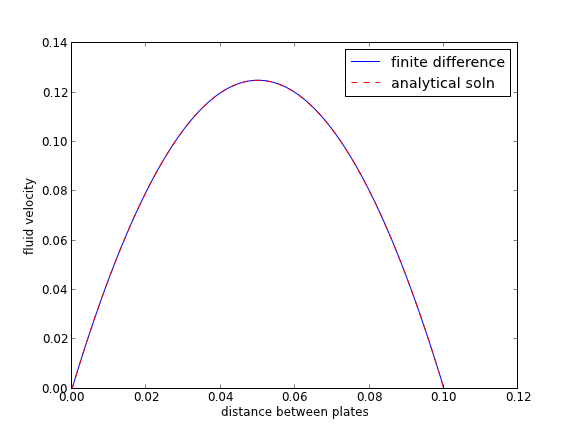
You can see excellent agreement here between the numerical and analytical solution.

Copyright (C) 2013 by John Kitchin. See the License for information about copying.
org-mode source

Discuss on Twitter

Find the minimum distance from a point to a curve.

| categories: optimization | tags:

A problem that can be cast as a constrained minimization problem is to find the minimum distance from a point to a curve. Suppose we have \(f(x) = x^2\), and the point (0.5, 2). what is the minimum distance from that point to \(f(x)\)?

import numpy as np
import matplotlib.pyplot as plt
from scipy.optimize import fmin_cobyla

P = (0.5, 2)

def f(x):
    return x**2

def objective(X):
    x,y = X
    return np.sqrt((x - P[0])**2 + (y - P[1])**2)

def c1(X):
    x,y = X
    return f(x) - y

X = fmin_cobyla(objective, x0=[0.5,0.5], cons=[c1])

print 'The minimum distance is {0:1.2f}'.format(objective(X))

# Verify the vector to this point is normal to the tangent of the curve
# position vector from curve to point
v1 = np.array(P) - np.array(X)
# position vector
v2 = np.array([1, 2.0 * X[0]])
print 'dot(v1, v2) = ',np.dot(v1, v2)

x = np.linspace(-2, 2, 100)

plt.plot(x, f(x), 'r-', label='f(x)')
plt.plot(P[0], P[1], 'bo', label='point')
plt.plot([P[0], X[0]], [P[1], X[1]], 'b-', label='shortest distance')
plt.plot([X[0], X[0] + 1], [X[1], X[1] + 2.0 * X[0]], 'g-', label='tangent')
plt.axis('equal')
plt.xlabel('x')
plt.ylabel('y')
plt.legend(loc='best')
plt.savefig('images/min-dist-p-func.png')
The minimum distance is 0.86
dot(v1, v2) =  0.000336477214214

   Normal return from subroutine COBYLA

   NFVALS =   44   F = 8.579598E-01    MAXCV = 0.000000E+00
   X = 1.300793E+00   1.692061E+00

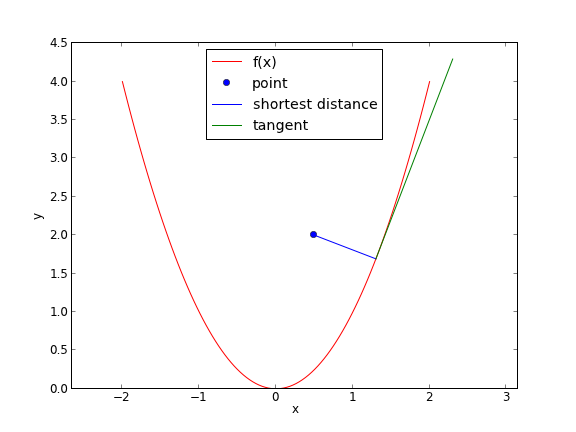
In the code above, we demonstrate that the point we find on the curve that minimizes the distance satisfies the property that a vector from that point to our other point is normal to the tangent of the curve at that point. This is shown by the fact that the dot product of the two vectors is very close to zero. It is not zero because of the accuracy criteria that is used to stop the minimization is not high enough.

Copyright (C) 2013 by John Kitchin. See the License for information about copying.

org-mode source

Discuss on Twitter

Numerically calculating an effectiveness factor for a porous catalyst bead

| categories: bvp | tags: reaction engineering

Matlab post

If reaction rates are fast compared to diffusion in a porous catalyst pellet, then the observed kinetics will appear to be slower than they really are because not all of the catalyst surface area will be effectively used. For example, the reactants may all be consumed in the near surface area of a catalyst bead, and the inside of the bead will be unutilized because no reactants can get in due to the high reaction rates.

References: Ch 12. Elements of Chemical Reaction Engineering, Fogler, 4th edition.

A mole balance on the particle volume in spherical coordinates with a first order reaction leads to: $\frac{d^2Ca}{dr^2} + \frac{2}{r}\frac{dCa}{dr}-\frac{k}{D_e}C_A=0$ with boundary conditions $C_A(R) = C_{As}$ and $\frac{dCa}{dr}=0$ at $r=0$. We convert this equation to a system of first order ODEs by letting $W_A=\frac{dCa}{dr}$. Then, our two equations become:

\(\frac{dCa}{dr} = W_A\)

and

\(\frac{dW_A}{dr} = -\frac{2}{r} W_A + \frac{k}{D_E} C_A\)

We have a condition of no flux ($W_A=0$) at r=0 and Ca(R) = CAs, which makes this a boundary value problem. We use the shooting method here, and guess what Ca(0) is and iterate the guess to get Ca(R) = CAs.

The value of the second differential equation at r=0 is tricky because at this place we have a 0/0 term. We use L'Hopital's rule to evaluate it. The derivative of the top is $\frac{dW_A}{dr}$ and the derivative of the bottom is 1. So, we have \(\frac{dW_A}{dr} = -2\frac{dW_A}{dr} + \frac{k}{D_E} C_A\)

Which leads to:

\(3 \frac{dW_A}{dr} =  \frac{k}{D_E} C_A\)

or \(\frac{dW_A}{dr} =  \frac{3k}{D_E} C_A\) at $r=0$.

Finally, we implement the equations in Python and solve.

import numpy as np
from scipy.integrate import odeint
import matplotlib.pyplot as plt

De = 0.1    # diffusivity cm^2/s
R = 0.5    # particle radius, cm
k = 6.4    # rate constant (1/s)
CAs = 0.2   # concentration of A at outer radius of particle (mol/L)


def ode(Y, r):
    Wa = Y[0]  # molar rate of delivery of A to surface of particle
    Ca = Y[1]  # concentration of A in the particle at r
    # this solves the singularity at r = 0
    if r == 0:
        dWadr = k / 3.0 * De * Ca
    else:
        dWadr = -2 * Wa / r + k / De * Ca
    dCadr = Wa
    return [dWadr, dCadr]

# Initial conditions
Ca0 = 0.029315  # Ca(0) (mol/L) guessed to satisfy Ca(R) = CAs
Wa0 = 0         # no flux at r=0 (mol/m^2/s)

rspan = np.linspace(0, R, 500)

Y = odeint(ode, [Wa0, Ca0], rspan)

Ca = Y[:, 1]

# here we check that Ca(R) = Cas
print 'At r={0} Ca={1}'.format(rspan[-1], Ca[-1])

plt.plot(rspan, Ca)
plt.xlabel('Particle radius')
plt.ylabel('$C_A$')
plt.savefig('images/effectiveness-factor.png')

r = rspan
eta_numerical = (np.trapz(k * Ca * 4 * np.pi * (r**2), r)
                 / np.trapz(k * CAs * 4 * np.pi * (r**2), r))

print(eta_numerical)

phi = R * np.sqrt(k / De)
eta_analytical = (3 / phi**2) * (phi * (1.0 / np.tanh(phi)) - 1)
print(eta_analytical)
At r=0.5 Ca=0.200001488652
[<matplotlib.lines.Line2D object at 0x114275550>]
<matplotlib.text.Text object at 0x10d5fe890>
<matplotlib.text.Text object at 0x10d5ff890>
0.563011348314

0.563003362801

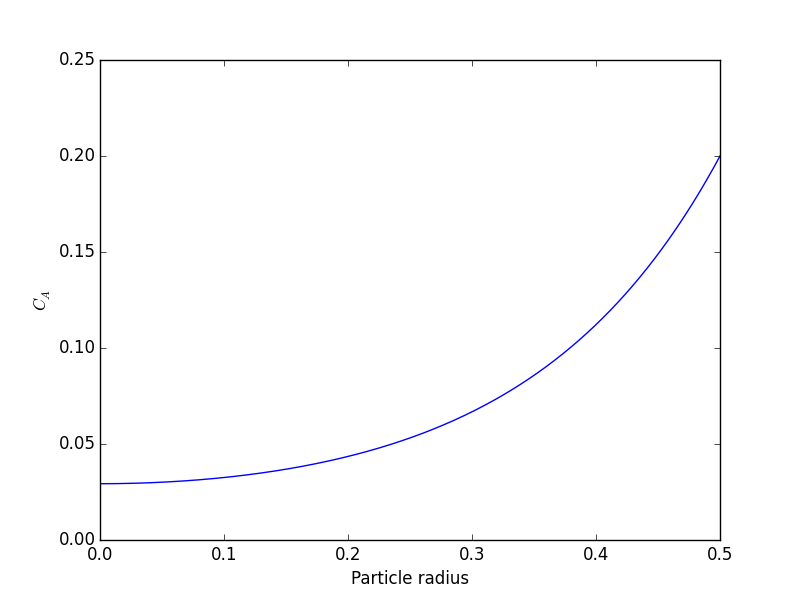
You can see the concentration of A inside the particle is significantly lower than outside the particle. That is because it is reacting away faster than it can diffuse into the particle. Hence, the overall reaction rate in the particle is lower than it would be without the diffusion limit.

The effectiveness factor is the ratio of the actual reaction rate in the particle with diffusion limitation to the ideal rate in the particle if there was no concentration gradient:

$$\eta = \frac{\int_0^R k'' a C_A(r) 4 \pi r^2 dr}{\int_0^R k'' a C_{As} 4 \pi r^2 dr}$$

We will evaluate this numerically from our solution and compare it to the analytical solution. The results are in good agreement, and you can make the numerical estimate better by increasing the number of points in the solution so that the numerical integration is more accurate.

Why go through the numerical solution when an analytical solution exists? The analytical solution here is only good for 1st order kinetics in a sphere. What would you do for a complicated rate law? You might be able to find some limiting conditions where the analytical equation above is relevant, and if you are lucky, they are appropriate for your problem. If not, it is a good thing you can figure this out numerically!

Thanks to Radovan Omorjan for helping me figure out the ODE at r=0!

Copyright (C) 2015 by John Kitchin. See the License for information about copying.

org-mode source

Org-mode version = 8.2.10

Discuss on Twitter

Nonlinear curve fitting with parameter confidence intervals

| categories: data analysis | tags:

Matlab post

We often need to estimate parameters from nonlinear regression of data. We should also consider how good the parameters are, and one way to do that is to consider the confidence interval. A confidence interval tells us a range that we are confident the true parameter lies in.

In this example we use a nonlinear curve-fitting function: scipy.optimize.curve_fit to give us the parameters in a function that we define which best fit the data. The scipy.optimize.curve_fit function also gives us the covariance matrix which we can use to estimate the standard error of each parameter. Finally, we modify the standard error by a student-t value which accounts for the additional uncertainty in our estimates due to the small number of data points we are fitting to.

We will fit the function \(y = a x / (b + x)\) to some data, and compute the 95% confidence intervals on the parameters.

# Nonlinear curve fit with confidence interval
import numpy as np
from scipy.optimize import curve_fit
from scipy.stats.distributions import  t

x = np.array([0.5, 0.387, 0.24, 0.136, 0.04, 0.011])
y = np.array([1.255, 1.25, 1.189, 1.124, 0.783, 0.402])

# this is the function we want to fit to our data
def func(x, a, b):
    'nonlinear function in a and b to fit to data'
    return a * x / (b + x)

initial_guess = [1.2, 0.03]
pars, pcov = curve_fit(func, x, y, p0=initial_guess)

alpha = 0.05 # 95% confidence interval = 100*(1-alpha)

n = len(y)    # number of data points
p = len(pars) # number of parameters

dof = max(0, n - p) # number of degrees of freedom

# student-t value for the dof and confidence level
tval = t.ppf(1.0-alpha/2., dof) 

for i, p,var in zip(range(n), pars, np.diag(pcov)):
    sigma = var**0.5
    print 'p{0}: {1} [{2}  {3}]'.format(i, p,
                                  p - sigma*tval,
                                  p + sigma*tval)

import matplotlib.pyplot as plt
plt.plot(x,y,'bo ')
xfit = np.linspace(0,1)
yfit = func(xfit, pars[0], pars[1])
plt.plot(xfit,yfit,'b-')
plt.legend(['data','fit'],loc='best')
plt.savefig('images/nonlin-curve-fit-ci.png')
p0: 1.32753141454 [1.3005365922  1.35452623688]
p1: 0.0264615569701 [0.0236076538292  0.0293154601109]
(array([ 1.32753141,  0.02646156]), [[1.3005365921998688, 1.3545262368760884], [0.023607653829234403, 0.029315460110926929]], [0.0097228006732683319, 0.0010278982773703883])

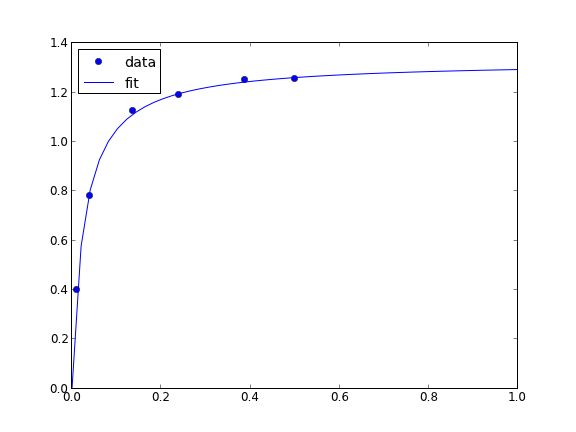
You can see by inspection that the fit looks pretty reasonable. The parameter confidence intervals are not too big, so we can be pretty confident of their values.

Copyright (C) 2013 by John Kitchin. See the License for information about copying.

org-mode source

Discuss on Twitter

Using constrained optimization to find the amount of each phase present

| categories: optimization | tags:

The problem we solve here is that we have several compounds containing Ni and Al, and a bulk mixture of a particular composition of Ni and Al. We want to know which mixture of phases will minimize the total energy. The tricky part is that the optimization is constrained because the mixture of phases must have the overall stoichiometry we want. We formulate the problem like this.

Basically, we want to minimize the function \(E = \sum w_i E_i\), where \(w_i\) is the mass of phase \(i\), and \(E_i\) is the energy per unit mass of phase \(i\). There are some constraints to ensure conservation of mass. Let us consider the following compounds: Al, NiAl, Ni3Al, and Ni, and consider a case where the bulk composition of our alloy is 93.8% Ni and balance Al. We want to know which phases are present, and in what proportions. There are some subtleties in considering the formula and molecular weight of an alloy. We consider the formula with each species amount normalized so the fractions all add up to one. For example, Ni_3Al is represented as Ni_{0.75}Al_{0.25}, and the molecular weight is computed as 0.75*MW_{Ni} + 0.25*MW_{Al}.

We use scipy.optimize.fmin_slsqp to solve this problem, and define two equality constraint functions, and the bounds on each weight fraction.

Note: the energies in this example were computed by density functional theory at 0K.

import numpy as np
from scipy.optimize import fmin_slsqp

# these are atomic masses of each species
Ni = 58.693
Al = 26.982

COMPOSITIONS = ['Al', 'NiAl',              'Ni3Al',  'Ni']
MW = np.array(  [Al,  (Ni + Al)/2.0, (3*Ni + Al)/4.0, Ni])

xNi = np.array([0.0, 0.5, 0.75, 1.0])  # mole fraction of nickel in each compd
WNi = xNi*Ni / MW                      # weight fraction of Ni in each cmpd

ENERGIES = np.array([0.0, -0.7, -0.5, 0.0])

BNi = 0.938

def G(w):
    'function to minimize. w is a vector of weight fractions, ENERGIES is defined above.'
    return np.dot(w, ENERGIES)

def ec1(w):
    'conservation of Ni constraint'
    return BNi - np.dot(w, WNi)

def ec2(w):
    'weight fractions sum to one constraint'
    return 1 - np.sum(w)

w0 = np.array([0.0, 0.0, 0.5, 0.5]) # guess weight fractions

y = fmin_slsqp(G,   
               w0,
               eqcons=[ec1, ec2], 
               bounds=[(0,1)]*len(w0))

for ci, wi in zip(COMPOSITIONS, y):
    print '{0:8s} {1:+8.2%}'.format(ci, wi)
Optimization terminated successfully.    (Exit mode 0)
            Current function value: -0.233299644373
            Iterations: 2
            Function evaluations: 12
            Gradient evaluations: 2
Al         -0.00%
NiAl       +0.00%
Ni3Al     +46.66%
Ni        +53.34%

So, the sample will be about 47% by weight of Ni3Al, and 53% by weight of pure Ni.

It may be convenient to formulate this in terms of moles.

import numpy as np
from scipy.optimize import fmin_slsqp

COMPOSITIONS = ['Al', 'NiAl', 'Ni3Al',  'Ni']
xNi = np.array([0.0, 0.5, 0.75, 1.0])   # define this in mole fractions

ENERGIES = np.array([0.0, -0.7, -0.5, 0.0]) 

xNiB = 0.875  # bulk Ni composition

def G(n):
    'function to minimize'
    return np.dot(n, ENERGIES)

def ec1(n):
    'conservation of Ni'
    Ntot = np.sum(n)
    return (Ntot * xNiB) - np.dot(n,  xNi)

def ec2(n):
    'mole fractions sum to one'
    return 1 - np.sum(n)

n0 = np.array([0.0, 0.0, 0.45, 0.55]) # initial guess of mole fractions

y = fmin_slsqp(G,   
               n0,
               eqcons=[ec1, ec2], 
               bounds=[(0, 1)]*(len(n0)))

for ci, xi in zip(COMPOSITIONS, y):
    print '{0:8s} {1:+8.2%}'.format(ci, xi)
Optimization terminated successfully.    (Exit mode 0)
            Current function value: -0.25
            Iterations: 2
            Function evaluations: 12
            Gradient evaluations: 2
Al         +0.00%
NiAl       -0.00%
Ni3Al     +50.00%
Ni        +50.00%

This means we have a 1:1 molar ratio of Ni and Ni_{0.75}Al_{0.25}. That works out to the overall bulk composition in this particular problem.

Let us verify that these two approaches really lead to the same conclusions. On a weight basis we estimate 53.3%wt Ni and 46.7%wt Ni3Al, whereas we predict an equimolar mixture of the two phases. Below we compute the mole fraction of Ni in each case.

# these are atomic masses of each species
Ni = 58.693
Al = 26.982

# Molar case
# 1 mol Ni + 1 mol Ni_{0.75}Al_{0.25}
N1 = 1.0; N2 = 1.0
mol_Ni = 1.0 * N1 + 0.75 * N2
xNi = mol_Ni / (N1 + N2)
print xNi

# Mass case
M1 = 0.533; M2 = 0.467
MW1 = Ni; MW2 = 0.75*Ni + 0.25*Al

xNi2 = (1.0 * M1/MW1 + 0.75 * M2 / MW2) / (M1/MW1 + M2/MW2)
print xNi2
0.875
0.874192746385

You can see the overall mole fraction of Ni is practically the same in each case.

Copyright (C) 2013 by John Kitchin. See the License for information about copying.

org-mode source

Discuss on Twitter
« Previous Page -- Next Page »