Benchmarks and results¶
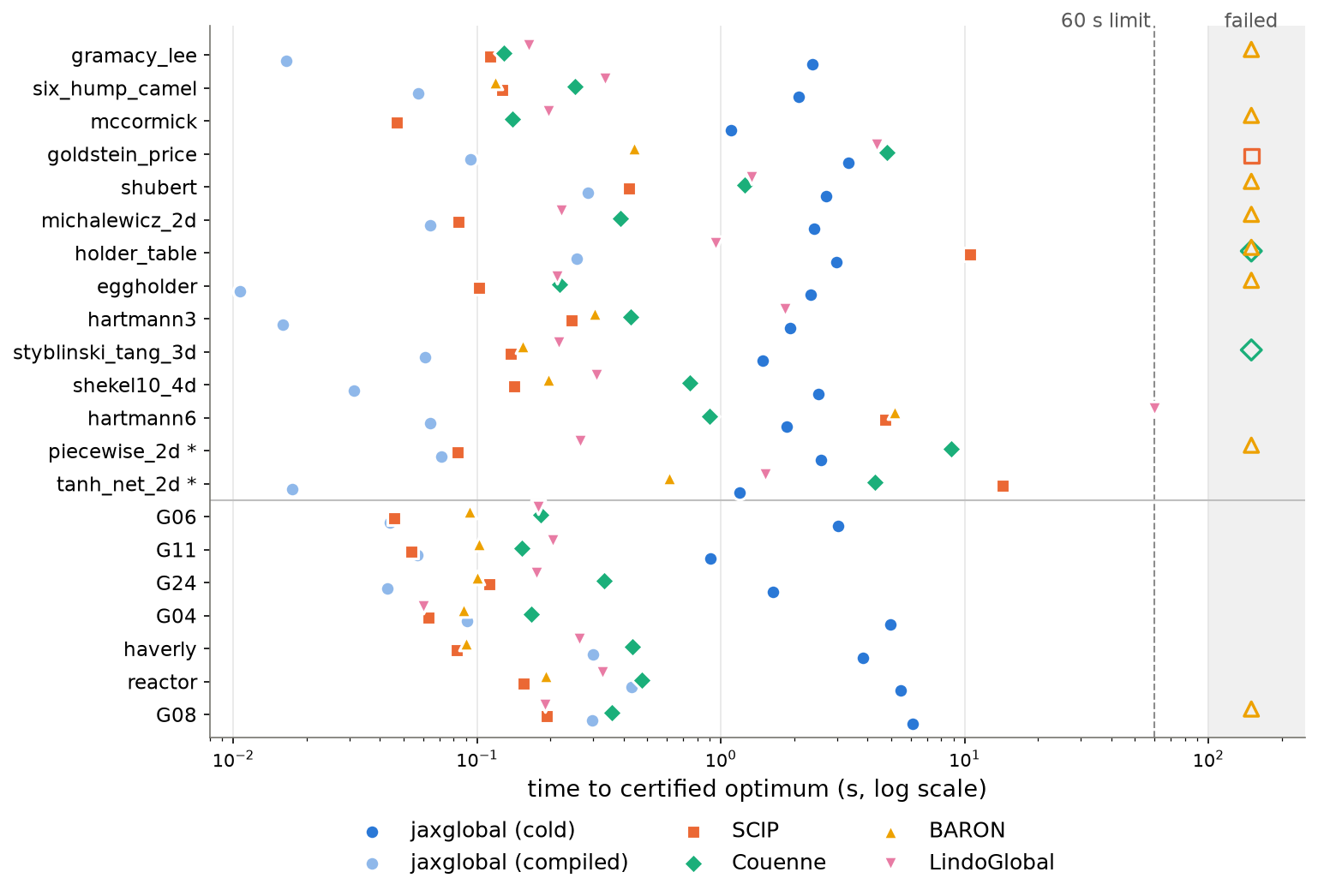
All times are wall clock on a laptop CPU. Cold times include tracing and compiling the bounding kernels, which dominate small problems.
MINLPLib¶
All answers are checked against the library's reference bounds. Outside MINLPLib, before PR #76 the solver certified a wrong optimum on an application model (two parallel lines with motor price lists: reported optimal 130186.35 while 130000.6 is attainable), caused by invalid subgradients at near-ties; this is now fixed.
- MINLPLib re-run on current code, 2026-10-20 (
mainat 9812f39: after PRs #76, #77 and #81). Every instance list is checked in underbenchmarks/sets/, every row is inbenchmarks/results/rerun_*.csv, andbenchmarks/rerun_report.pyprints this table (benchmarks/rerun_2026_10.shreproduces the runs). Same pass rule as below. Machine: a 4-core 2.1 GHz Xeon cloud VM, two solves at a time, 60 s limit; SCIP 10.0 throughpyscipopt6.3; no BARON.
| set | instances | solved, cold / warm | pass, cold | pass, warm | where SCIP takes ≥ 0.5 s (warm) | jaxglobal faster than SCIP (warm) | wrong: jaxglobal / SCIP | SCIP solved |
|---|---|---|---|---|---|---|---|---|
| global50 | 48 | 40 / 42 | 6 | 33 | 0 / 3 | 0 | 0 / 0 | 44 |
start50 |
50 | 37 / 40 | 15 | 36 | 7 / 11 | 1 | 0 / 1 | 38 |
int50 |
50 | 37 / 43 | 9 | 27 | 4 / 14 | 3 | 0 / 0 | 47 |
| held out | 209 | 169 / 180 | 66 | 157 | 11 / 41 | 2 | 0 / 1 | 204 |
- Wrong answers: none from jaxglobal in any set or mode. SCIP 10.0
returns a wrong optimum on ex8_5_3 (
start50) and st_qpc-m3b (held out). - This machine is much slower than the laptop used below, and that, not
the code, explains the lower counts. On seven instances that fail here,
the pre-#76 code (58bb551) and current
mainbehave the same on this machine: the same six time out, flay03m solves in about 9 s warm, and the warm node counts agree (results/ab_{old,new}_{cold,warm}.csv). nvs09, which took 44 s cold and 2.6 s warm on the laptop, does not finish compiling in 60 s here. Cold passes suffer most: compilation alone often exceeds the 10 s floor. - Held-out set.
sets/heldout.txtfollows the definition given below, with 209 names instead of 184, because the original also excluded acheck_wrong.pyrandom sample that cannot be reproduced. The 79-instance development set was never recorded, so it is not re-run;start50andint50, which it was drawn from, are reported instead. -
global50 is discopt's BARON panel (
sets/global50.txt); casctanks and hda are not in this repo's MINLPLib tables. jaxglobal does not solve clay0303hfsg, cvxnonsep_psig30, flay03m, nvs09, tanksize or tspn05 (warm); SCIP does not solve cvxnonsep_nsig30, cvxnonsep_psig30, st_e36 or tspn05. -
MINLPLib against SCIP, October 2026 (
mainat 58bb551). An instance passes if jaxglobal proves it optimal within max(2 x SCIP's time, 10 s). "Cold" includes JAX compilation; "warm" reuses the compile caches from a previous run. SCIP has no compile step, so the cold numbers are the fair comparison. Measured at 58bb551 (2026-10-19) on a laptop, before PR #76 (relaxation subgradient fix); the re-run on current code, on a slower machine, is above.
| set | instances | pass, cold | pass, warm | where SCIP takes ≥ 0.5 s (warm) |
|---|---|---|---|---|
| development: the targets the recent solver work was tuned on | 79 | 68 | 74 | 20 / 23 |
| held out: same families, never used during development | 184 | 151 | 160 | 10 / 26 |
- Development set. It is drawn from
start50andint50(41 of the 79 have integer variables). Recent PRs fixed these instances one by one, so the numbers above are optimistic. The 5 still failing, and why, are listed indocs/PLAN-scip-gap-v2.md§10. - Held-out set. Every MINLPLib instance with a SCIP reference time
that was not used during development: not in
start50,int50or thecheck_wrongsample, and not named in the code, tests or docs. The set is easier than the development set: all continuous, with a median of 6 variables and a median SCIP time of 0.03 s.- Easy instances (SCIP < 0.5 s) generalize: 150 of 158 pass, warm.
- Harder instances do not: 10 of 26, against 20 of 23 on the development set.
- 11 are rejected as unsupported, because bound propagation finds no finite bounds for some variables.
- Speed. jaxglobal beats SCIP's time on only 8 of the development instances and 3 of the held-out ones. Most passes rely on the 10 s floor.
- Wrong answers: 0 in either set.
-
To reproduce: run
benchmarks/run.py --solvers jaxglobal,scip --names
    <list> --time-limit 60
once withJAXGLOBAL_CACHE=0(cold) and again on a primed cache (warm), then apply the pass rule per instance against SCIP's time.run.pytakes a single time limit, so the rule is applied afterwards. The development list was not checked in; the held-out set is defined above, and a reconstruction is inbenchmarks/sets/heldout.txt. -
global50, 60 s limit (the 50-instance BARON comparison panel from discopt,
discopt_benchmarks/config/baron_global50.txt). All solvers ran on the same machine. 48 of the 50 ran; casctanks and hda are missing from this repo's MINLPLib tables. Measured at 58bb551 (2026-10-19) on a laptop, before PR #76; re-run above (without BARON).
| solved in 60 s | wrong answers | not solved in 60 s | |
|---|---|---|---|
| jaxglobal, cold | 45 / 48 | 0 | clay0303hfsg, cvxnonsep_psig30, tanksize |
| jaxglobal, warm | 45 / 48 | 0 | the same three |
SCIP (command line, .nl) |
45 / 48 | 0 | cvxnonsep_nsig30, st_e36, tspn05 |
| BARON (GAMS) | 47 / 48 | 1 (nvs05: reports 5.887 as optimal; the optimum is 5.471) | — |
- Development overlap. 11 of the 48 are in the development set above, and every solver solves all 11. On the other 37, jaxglobal and SCIP each solve 34.
- Under the 2 x SCIP / 10 s rule: 40 of 48 pass cold and 45 warm. nvs09 takes 44 s cold and 2.6 s warm, so compilation dominates the cold misses.
-
Speed. SCIP and BARON solve most of these instances in under 0.1 s; jaxglobal takes 0.5–8 s warm. jaxglobal solves cvxnonsep_nsig30, st_e36 and tspn05, which SCIP leaves unsolved, but BARON solves all three faster.
-
MINLPLib, 60 s limit, cold start (compilation included), measured on 2026-10-17, before the SCIP-gap work and PR #76, and not re-run since:
| set | jaxglobal | SCIP |
|---|---|---|
start50: 50 continuous instances, ≤ 50 variables, weighted toward hard ones |
31 | 44 |
int50: 50 mixed-integer instances, ≤ 50 variables |
29 | 45 |
The sets are defined in benchmarks/sets/README.md;
the 31 and 29 are the issue #14 cold runs in docs/ROADMAP.md
(results/issue14_*_cold.csv).
Branching comparisons (Solver options) were separate runs, so their counts differ.
On 328 mixed-integer MINLPLib instances with up to 100 variables (60 s, cold, measured on 2026-10-17, before the SCIP-gap work and PR #76; re-run pending), jaxglobal solved 72 of the 220 with at most 50 variables and 1 of the 108 with 51 to 100.
Running the MINLPLib benchmark¶
From a clone of the repository:
python benchmarks/minlplib/fetch.py          # 322 continuous instances, ≤ 50 variables
python benchmarks/run.py --time-limit 60     # jaxglobal, SCIP, Couenne, BARON (GAMS)
python benchmarks/report.py                  # checked results, SGM time, profiles
python benchmarks/check_wrong.py             # exits nonzero on any wrong or unverified answer
Built-in test problems¶
From notebook 03.
Tolerance: gap ≤ max(1e-5, 1e-6·|f|). Root LB is plain interval arithmetic on the whole box. mstart is the fraction of 20 random L-BFGS-B starts that reach f*, which shows how multimodal each problem is.
| problem | n | f* (lit.) | found | proven LB | root LB | mstart | nodes | time |
|---|---|---|---|---|---|---|---|---|
| gramacy_lee | 1 | −0.869011 | −0.869011 | −0.869011 | −1 | 15% | 5 | 10.7s |
| six_hump_camel | 2 | −1.031628 | −1.031628 | −1.031629 | −156 | 95% | 23 | 7.5s |
| mccormick | 2 | −1.913223 | −1.913223 | −1.913224 | −13.5 | 55% | 11 | 7.0s |
| goldstein_price | 2 | 3.000000 | 3.000000 | 2.999998 | −8.79e7 | 60% | 1447 | 18.1s |
| shubert | 2 | −186.730909 | −186.730909 | −186.731070 | −225 | 0% | 277 | 18.0s |
| michalewicz_2d | 2 | −1.801303 | −1.801301 | −1.801303 | −2 | 5% | 9 | 14.9s |
| holder_table | 2 | −19.208503 | −19.208503 | −19.208518 | −33.2 | 0% | 279 | 18.5s |
| eggholder | 2 | −959.640663 | −959.640663 | −959.640711 | −1.07e3 | 0% | 41 | 12.6s |
| hartmann3 | 3 | −3.862782 | −3.862780 | −3.862786 | −8.4 | 50% | 89 | 11.3s |
| styblinski_tang_3d | 3 | −117.498497 | −117.498497 | −117.498551 | −638 | 15% | 9 | 9.6s |
| shekel10_4d | 4 | −10.536443† | −10.536443 | −10.536453 | −35.4 | 25% | 67 | 11.1s |
| hartmann6 | 6 | −3.322368 | −3.322368 | −3.322377 | −8.4 | 55% | 1035 | 11.2s |
| piecewise_2d (where/abs/max) | 2 | — | −0.823199 | −0.823202 | −3.7 | 25% | 31 | 16.8s |
| tanh_net_2d (16-unit MLP) | 2 | — | −0.553102 | −0.553105 | −2.8 | 30% | 239 | 8.6s |
† The usual −10.5364 is f(4,4,4,4); the true minimizer is slightly off that point.
Times are wall-clock on a laptop CPU for a first (cold) call, so they are
mostly JIT compilation; a second solve of the same function reuses the
compiled kernels and takes a small fraction of that (see notebook 04). For the two
problems without a published optimum, the tests check the certificate against
a 401×401 brute-force grid. Re-run on 2026-10-20 on current main (after PRs
76, #77 and #81) on a 4-core 2.1 GHz cloud VM; the node counts are within a few¶
nodes of the earlier laptop run at 2ae4c39, and the times are 4–8× longer, most of it compilation on the slower machine.
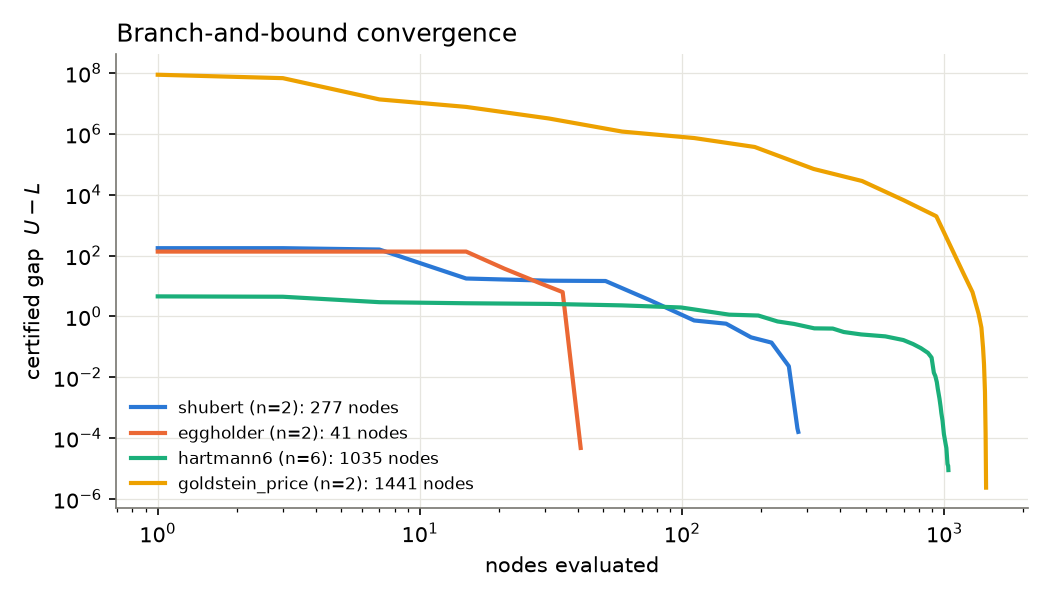
Excluded on purpose: sum-of-squares problems with f* = 0 (Rosenbrock, Himmelblau, Rastrigin, Ackley, Levy) and Branin. Plain interval arithmetic already proves their optimum at the root node, so they show nothing about the relaxations.
Comparison with equation-based solvers¶
notebooks/compare.py builds Pyomo models from the same Python functions,
using a jnp→Pyomo shim on numpy object arrays. It then runs SCIP and Couenne
(via .nl files) and BARON and LindoGlobal (via GAMS). where/maximum and
tanh had to be reformulated by hand; jaxglobal.export
now does that automatically. BARON rejects every model containing
sin/cos ("Cannot handle function 'sin'"). Results go to
notebooks/results/compare_results.json. The notebook
notebook 04
walks through the shim and the reformulations, re-measures jaxglobal (cold,
including compilation, and compiled), and draws figures/benchmark.png.
Pyomo side by side. The Pyomo comparison notebooks
write each model twice, in Pyomo and as a plain JAX function, and solve both:
basic and pooling problems, where/clip/table lookups, RK4 kinetics, NN
surrogates, and things Pyomo cannot express directly.
Flagship benchmark. jaxglobal.applications holds code-defined models
(RK4 ODE kinetics stepped with lax.scan, regime-switching engineering models, tanh NN surrogates after
Schweidtmann & Mitsos 2018), each with a hand-written Pyomo twin.
benchmarks/flagship.py runs jaxglobal, SCIP, Couenne and BARON on them and
judges each answer against the best known optimum.