
jaxglobal¶
Global optimization of plain JAX functions.
Write an ordinary Python function with jax.numpy, give a box, and get a
certified global minimum: an upper bound (a feasible point) and a proven
lower bound. You write no equations and no algebraic model.
import jax.numpy as jnp
from jaxglobal import minimize

def f(x):                       # Eggholder: very rugged, optimum on the boundary
    a, b = x[0], x[1]
    return -(b + 47) * jnp.sin(jnp.sqrt(jnp.abs(a / 2 + b + 47))) \
           - a * jnp.sin(jnp.sqrt(jnp.abs(a - (b + 47))))

r = minimize(f, [-512, -512], [512, 512])
# Result(status='optimal', fun=-959.64066, lower_bound=-959.64071, gap=4.78e-05,
#        x=[512. 404.231805], nodes=41, iterations=8, time=1.97s)
Status¶
jaxglobal is past the proof-of-concept stage. It is a research solver: usable, tested, and measured on MINLPLib, but not yet competitive with mature global solvers on general problems (see Limitations).
- Problems: continuous and mixed-integer, with inequality and equality
constraints, on finite or partly unbounded boxes. Models can be plain JAX
functions or AMPL
.nlfiles (jaxglobal.nl.read_nl). - Correct answers so far: 0 wrong answers on the MINLPLib sets below, all
checked against the library's reference bounds. Every returned point is
re-checked in float64, and an opt-in
safe=Truemode rounds the bounds outward. Outside MINLPLib, before PR #76 the solver certified a wrong optimum on an application model (two parallel lines with motor price lists: reported optimal 130186.35 while 130000.6 is attainable), caused by invalid subgradients at near-ties; this is now fixed. - MINLPLib re-run on current code, 2026-10-20 (
mainat 9812f39: after PRs #76, #77 and #81). Every instance list is checked in underbenchmarks/sets/, every row is inbenchmarks/results/rerun_*.csv, andbenchmarks/rerun_report.pyprints this table (benchmarks/rerun_2026_10.shreproduces the runs). Same pass rule as below. Machine: a 4-core 2.1 GHz Xeon cloud VM, two solves at a time, 60 s limit; SCIP 10.0 throughpyscipopt6.3; no BARON.
| set | instances | solved, cold / warm | pass, cold | pass, warm | where SCIP takes ≥ 0.5 s (warm) | jaxglobal faster than SCIP (warm) | wrong: jaxglobal / SCIP | SCIP solved |
|---|---|---|---|---|---|---|---|---|
| global50 | 48 | 40 / 42 | 6 | 33 | 0 / 3 | 0 | 0 / 0 | 44 |
start50 |
50 | 37 / 40 | 15 | 36 | 7 / 11 | 1 | 0 / 1 | 38 |
int50 |
50 | 37 / 43 | 9 | 27 | 4 / 14 | 3 | 0 / 0 | 47 |
| held out | 209 | 169 / 180 | 66 | 157 | 11 / 41 | 2 | 0 / 1 | 204 |
- Wrong answers: none from jaxglobal in any set or mode. SCIP 10.0
returns a wrong optimum on ex8_5_3 (
start50) and st_qpc-m3b (held out). - This machine is much slower than the laptop used below, and that, not
the code, explains the lower counts. On seven instances that fail here,
the pre-#76 code (58bb551) and current
mainbehave the same on this machine: the same six time out, flay03m solves in about 9 s warm, and the warm node counts agree (results/ab_{old,new}_{cold,warm}.csv). nvs09, which took 44 s cold and 2.6 s warm on the laptop, does not finish compiling in 60 s here. Cold passes suffer most: compilation alone often exceeds the 10 s floor. - Held-out set.
sets/heldout.txtfollows the definition given below, with 209 names instead of 184, because the original also excluded acheck_wrong.pyrandom sample that cannot be reproduced. The 79-instance development set was never recorded, so it is not re-run;start50andint50, which it was drawn from, are reported instead. -
global50 is discopt's BARON panel (
sets/global50.txt); casctanks and hda are not in this repo's MINLPLib tables. jaxglobal does not solve clay0303hfsg, cvxnonsep_psig30, flay03m, nvs09, tanksize or tspn05 (warm); SCIP does not solve cvxnonsep_nsig30, cvxnonsep_psig30, st_e36 or tspn05. -
MINLPLib against SCIP, October 2026 (
mainat 58bb551). An instance passes if jaxglobal proves it optimal within max(2 x SCIP's time, 10 s). "Cold" includes JAX compilation; "warm" reuses the compile caches from a previous run. SCIP has no compile step, so the cold numbers are the fair comparison. Measured at 58bb551 (2026-10-19) on a laptop, before PR #76 (relaxation subgradient fix); the re-run on current code, on a slower machine, is above.
| set | instances | pass, cold | pass, warm | where SCIP takes ≥ 0.5 s (warm) |
|---|---|---|---|---|
| development: the targets the recent solver work was tuned on | 79 | 68 | 74 | 20 / 23 |
| held out: same families, never used during development | 184 | 151 | 160 | 10 / 26 |
- Development set. It is drawn from
start50andint50(41 of the 79 have integer variables). Recent PRs fixed these instances one by one, so the numbers above are optimistic. The 5 still failing, and why, are listed indocs/PLAN-scip-gap-v2.md§10. - Held-out set. Every MINLPLib instance with a SCIP reference time
that was not used during development: not in
start50,int50or thecheck_wrongsample, and not named in the code, tests or docs. The set is easier than the development set: all continuous, with a median of 6 variables and a median SCIP time of 0.03 s.- Easy instances (SCIP < 0.5 s) generalize: 150 of 158 pass, warm.
- Harder instances do not: 10 of 26, against 20 of 23 on the development set.
- 11 are rejected as unsupported, because bound propagation finds no finite bounds for some variables.
- Speed. jaxglobal beats SCIP's time on only 8 of the development instances and 3 of the held-out ones. Most passes rely on the 10 s floor.
- Wrong answers: 0 in either set.
-
To reproduce: run
benchmarks/run.py --solvers jaxglobal,scip --names
    <list> --time-limit 60
once withJAXGLOBAL_CACHE=0(cold) and again on a primed cache (warm), then apply the pass rule per instance against SCIP's time.run.pytakes a single time limit, so the rule is applied afterwards. The development list was not checked in; the held-out set is defined above, and a reconstruction is inbenchmarks/sets/heldout.txt. -
global50, 60 s limit (the 50-instance BARON comparison panel from discopt,
discopt_benchmarks/config/baron_global50.txt). All solvers ran on the same machine. 48 of the 50 ran; casctanks and hda are missing from this repo's MINLPLib tables. Measured at 58bb551 (2026-10-19) on a laptop, before PR #76; re-run above (without BARON).
| solved in 60 s | wrong answers | not solved in 60 s | |
|---|---|---|---|
| jaxglobal, cold | 45 / 48 | 0 | clay0303hfsg, cvxnonsep_psig30, tanksize |
| jaxglobal, warm | 45 / 48 | 0 | the same three |
SCIP (command line, .nl) |
45 / 48 | 0 | cvxnonsep_nsig30, st_e36, tspn05 |
| BARON (GAMS) | 47 / 48 | 1 (nvs05: reports 5.887 as optimal; the optimum is 5.471) | — |
- Development overlap. 11 of the 48 are in the development set above, and every solver solves all 11. On the other 37, jaxglobal and SCIP each solve 34.
- Under the 2 x SCIP / 10 s rule: 40 of 48 pass cold and 45 warm. nvs09 takes 44 s cold and 2.6 s warm, so compilation dominates the cold misses.
-
Speed. SCIP and BARON solve most of these instances in under 0.1 s; jaxglobal takes 0.5–8 s warm. jaxglobal solves cvxnonsep_nsig30, st_e36 and tspn05, which SCIP leaves unsolved, but BARON solves all three faster.
-
MINLPLib, 60 s limit, cold start (compilation included), measured on 2026-10-17, before the SCIP-gap work and PR #76, and not re-run since:
| set | jaxglobal | SCIP |
|---|---|---|
start50: 50 continuous instances, ≤ 50 variables, weighted toward hard ones |
31 | 44 |
int50: 50 mixed-integer instances, ≤ 50 variables |
29 | 45 |
The sets are defined in benchmarks/sets/README.md;
the 31 and 29 are the issue #14 cold runs in docs/ROADMAP.md
(results/issue14_*_cold.csv).
Branching comparisons (Solver options) were separate runs, so their counts differ.
* What it is for: problems defined by code, which equation-based solvers
cannot read at all or need rewritten by hand: jnp.where logic,
neural-network and Gaussian-process surrogates, ODE kinetics integrated by
fixed-step loops (Python loops or lax.scan).
Narrated, executed notebooks walk through the relaxations, branch and bound, the test problems, the comparison with equation-based solvers, batched throughput and Gaussian-process surrogates (01–06), then compare jaxglobal with Pyomo model by model (07–13).
How it works¶
- Trace.
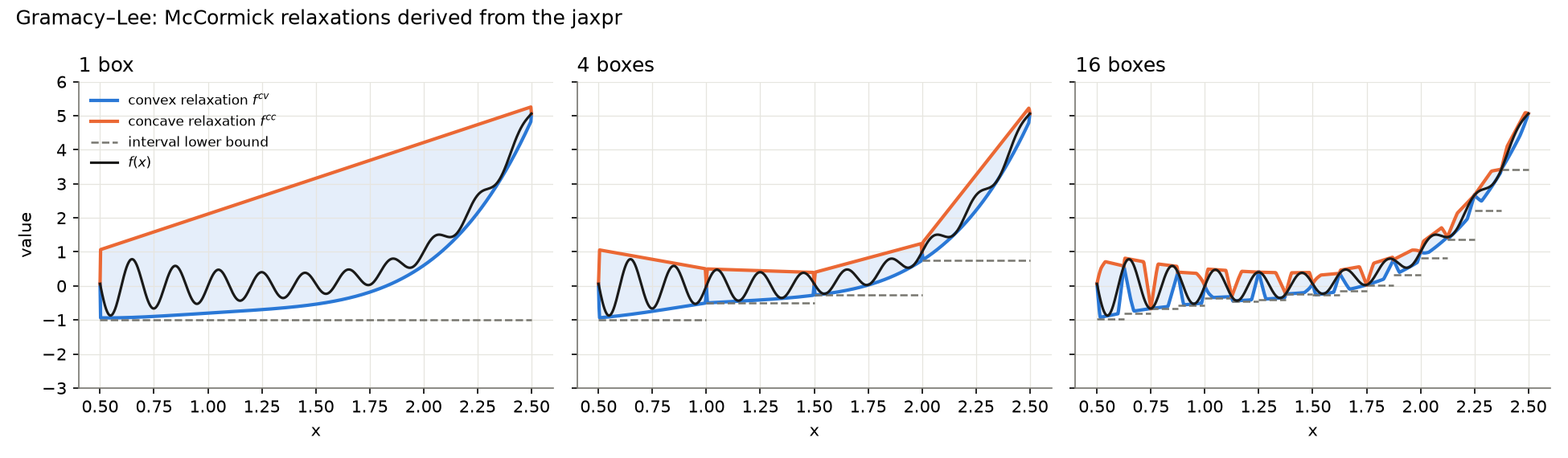
jax.make_jaxpr(f)turns the Python function into a flat list of primitives (sin,mul,integer_pow,dot_general,slice, …). Python loops, helper functions,jnp.where,jax.nn.*, andjit/custom_jvpsub-calls all disappear into this list. - Re-interpret the jaxpr on McCormick objects
MC(lo, hi, cv, cc)injaxglobal/relax.py. Every primitive has a rule: - structural / positive-linear primitives (slice, reshape, add, reduce_sum, concatenate, gather, …) apply component-wise;
- signed linear (neg, sub, mul or
dot_generalby a constant) swap by sign; - bilinear
muluses the McCormick product rule; - univariate primitives use McCormick composition with known envelopes
(exp, log, sqrt, xⁿ, |x|, 1/x, pow, cosh, max/min) or an automatically
derived αBB relaxation. For sin, cos, tanh, logistic, erf, atan, …, the
interpreter traces
jax.grad(jax.grad(prim)), evaluates that jaxpr in interval mode to bound f″, and buildsf(z) ± α/2 (z−lo)(z−hi). Adding a new smooth primitive needs only its range function. - comparisons /
select_n(fromjnp.where) are resolved when the interval decides the branch and fall back to the hull otherwise. - The relaxation is itself a JAX function, so it can be
jit-ed,vmap-ed over hundreds of boxes, and differentiated.jax.grad(cv)gives subgradients of the convex relaxation. Frank–Wolfe steps on cv (n_fw=20) give affine cutscv(x) + g·(v − x), whose minimum over the box is a valid lower bound (jaxglobal/bnb.py). - Batched spatial branch-and-bound. Each iteration splits the
batch // 2(128 by default) lowest-bound boxes and bounds the children with ajit(vmap(...))kernel, in calls ofbatch_sizesboxes (16 by default). A local NLP solve (pounce when installed, otherwise optax) polishes the incumbent. - Bound tightening against the incumbent (
f <= UB), all batched: - FBBT (
jaxglobal/fbbt.py): the jaxpr is flattened into a tape and swept forward (interval rules) and backward (inverse rules:x ∈ Z − Yfor add,x ∈ log Zfor exp, the two-sided root forx²ⁿand|x|, …) to a fixed number of rounds before every node is bounded; - duality-based range reduction: the cut / LP-dual certificate
f ≥ lb + Σ r_j (x_j − lo_j)confines each variable to where it could still beat the incumbent, at no extra cost; - OBBT (
lp.make_obbt): min and max of every variable over the outer-approximation LP, as 2nvmap-ed LPs with weak-duality-certified results; on the root by default (obbt="tree"for every node). Children are split from the tightened box. - Univariate envelopes (
jaxglobal/univariate.py, on by default). Every smooth sub-expression whose elements each depend on one variable (found structurally on the jaxpr: separable sums, polynomial factors,sin(x)·sin(x²)^20, ...) is sampled on a 65-point grid. The samples are lowered bymax(g″, 0)·h²/8, withg″bounded per cell by interval evaluation ofjvp(jvp(g)), and their lower convex hull is a nearly exact convex envelope (symmetrically for the concave one). It is intersected with the McCormick relaxation, so it never loosens it. On Styblinski–Tang the root bound goes from −612 to −118.6 (f* = −117.5). An extended-space LP bound (jaxglobal/lifted.py,lifted=True) is also available: one LP column per nonlinear jaxpr node, cut from that node's own McCormick rule at FBBT-tightened bounds.
Where to go next¶
- Installation and quickstart
- Modelling: objectives, constraints, integers, GP surrogates,
.nlfiles - Solver options: every argument of
minimize, including branching - Benchmarks and results
- jaxglobal and discopt: how this solver differs from discopt
- API reference
To cite jaxglobal, use doi:10.5281/zenodo.23478503 (see Citing and license).