Gases and pressure
Two effects matter for gas–water systems above a few atmospheres. Gases stop being ideal, and every equilibrium constant changes with pressure. Both follow PHREEQC's conventions, so results agree with PHREEQC 3 to the digits in Validation.
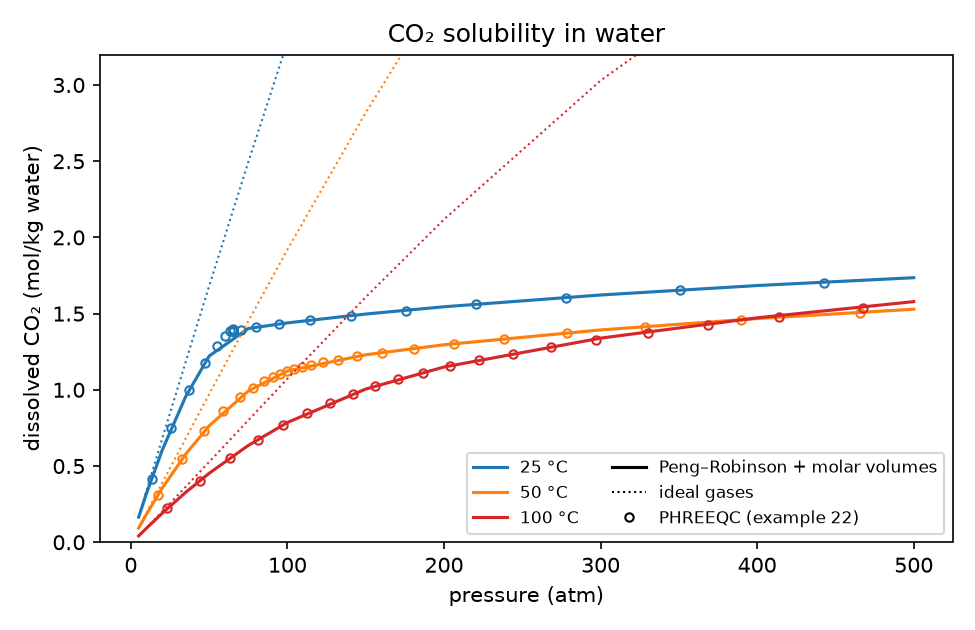
Dissolved CO₂ in pure water under a CO₂ + H₂O(g) gas phase. The solid lines use Peng–Robinson gases and pressure-dependent \(\log K\), the dotted lines ideal gases, and the circles are PHREEQC's example 22. Above about 50 atm an ideal gas overestimates the solubility several-fold. The 25 °C curve flattens near 65 atm, where CO₂ condenses.
import numpy as np
from discopt.speciation import PhreeqcDatabase, fit

db = PhreeqcDatabase.load("phreeqc.dat")
dissolved_c = fit.total("CO2", "HCO3-", "CO3-2", "(CO2)2", weights=[1, 1, 1, 2])
for p in (10.0, 100.0, 300.0):
    s = db.system(["C(4)"], gas_phase={"members": ["CO2(g)", "H2O(g)"], "pressure": p})
    r = s.equilibrate({"CO2(g)": 50.0}, T=323.15)          # excess CO2; P is the gas phase's
    print(p, r.pressure, round(dissolved_c(r), 4), r.fugacity_coefficient["CO2(g)"])
The full script for the figure is in
docs/figures/make_figures.py.
Non-ideal gases
A gas's activity is its fugacity \(f_j = \varphi_j x_j P\), and its saturation index is \(\log_{10} f_j\). Gases with critical constants follow the Peng–Robinson equation of state, with PHREEQC's constants, mixing rule and default binary parameters (Søreide and Whitson 1992).
| situation | what is solved |
|---|---|
| gas phase at fixed pressure | composition, molar volume (the vapor root) and whether it is present |
| gas phase at fixed volume | the amounts, from \(f_j(n, V) = 10^{\mathrm{SI}_j}\); the pressure follows |
fixed={"CO2(g)": log P} |
the fugacity \(\varphi(T, P)\,P\) of the pure gas, as PHREEQC's EQUILIBRIUM_PHASES |
Constants. The database gases take \(T_c\), \(P_c\) and \(\omega\) from -T_c,
-P_c and -Omega in phreeqc.dat, pitzer.dat and wateq4f_PWN.dat. Give your
own with s.gas("Ar(g)", Tc=150.8, Pc=48.0, omega=0.0) or
s.critical_constants(...), and binary parameters with kij= on the gas phase
or GAS_BINARY_PARAMETERS in a database file. See
custom data.
Results. r.partial_pressure is \(x_j P\), r.fugacity_coefficient is
\(\varphi_j\), and r.gas_phases[name] has the pressure, volume, molar volume and
composition.
Turning it off. System(gas_eos="ideal"), db.system(..., gas_eos="ideal")
or eos="ideal" on one gas phase.
Pressure-dependent log K
Above 1 atm each \(\log K\) changes with the volume change of its reaction,
\(\Delta V_r = \sum_i \nu_{ri} V_i(T, P, I)\), built from the species molar volumes
(PHREEQC's -Vm; Appelo, Parkhurst and Post 2014):
The ionic volumes depend on the ionic strength, so above 1 atm \(\log K\) does too, and it is solved together with the rest of the state. Water's density, compressibility and dielectric constant follow the pressure, so do the Debye–Hückel \(A\) and \(B\), and the Pitzer model lowers its \(b\) for ions with \(|z| = 1, 2\), as PHREEQC does. llnl.dat has no molar volumes, so its constants do not depend on pressure. Details are in Concepts.
s = db.system(["Ca", "C(4)"], phases=["Calcite"])
for p in (1.0, 100.0, 500.0):
    r = s.equilibrate({"Calcite": 1.0}, P=p)
    print(p, r.molality["Ca+2"])          # calcite dissolves more under pressure (dV < 0)
Which pressure
equilibrate(P=...) sets the pressure. Without it the pressure is, as in PHREEQC:
- the pressure of a fixed-pressure gas phase;
- else the computed pressure of a fixed-volume gas phase (found together with the equilibrium);
- else the largest fixed partial pressure of a Peng–Robinson gas;
- else 1 atm.
It is never below the vapor pressure of the solution, \(p_{sat}(T)\,a_w\), which
matters above 100 °C. r.pressure reports the value used. Sensitivities include
the pressure when it follows the state.
Limits
- Condensation. A gas that condenses (CO₂ below 31 °C above ~65 atm) is not a separate liquid phase. A fixed-volume gas follows the vapor side from the ideal gas and can become dense and liquid-like, as in PHREEQC. Inside the liquid–vapor loop PHREEQC caps the pressure and the package does not, so they differ there by up to 4e-3 in pH (Validation).
- Methods.
method="gibbs"andoptimizedo not support Peng–Robinson gases;gibbsand the global optimizer need \(\log K\) independent of the ionic strength, so they refuse calculations above 1 atm that use molar volumes. - Range. PHREEQC's water correlations are fitted to 350 °C and 1000 atm; its pressure is capped at 1500 atm.